Call +1 (647) 367-1424 WhatsApp Get a Free Estimate
Free On-Site Estimates • Full Cleanup Included • Serving Hinds, Rankin & Madison Counties
When a Tree Removal Needs a Crane
Most tree removal jobs are handled by skilled climbers with ropes and rigging. But some trees demand a crane. Here's when we recommend crane-assisted removal:
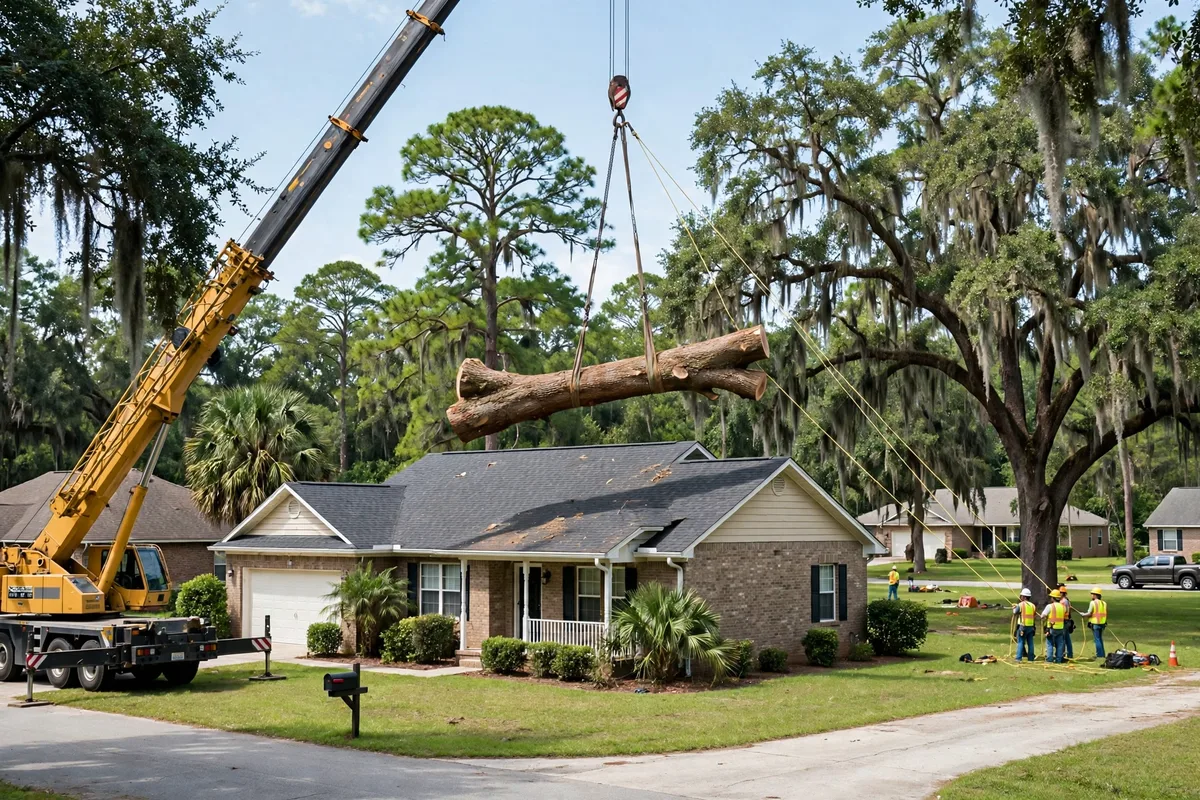
The tree overhangs your home. A 90-foot pine leaning over the roof, a massive oak limb spread covering the entire house — when there's no safe drop zone, the crane lifts each cut section vertically and swings it clear. Nothing falls; everything is flown out.
Tight-access lots. Mature Jackson neighborhoods — parts of Madison, Ridgeland, and older Jackson proper — have large trees on small lots with houses, fences, pools, and power lines on every side. When rigging lines have nowhere to run, the crane provides the lift that ropes can't.
Dead or structurally compromised trees. A dead pine or a decayed oak may be too brittle for a climber to work safely — spikes and ropes on rotting wood are a recipe for failure. The crane lets us dismantle the tree without putting a climber in the compromised canopy.
Very large specimens. Heritage-sized live oaks and towering pines produce sections weighing thousands of pounds. Crane picks handle weight that would overwhelm ground-based rigging, making the job faster and dramatically safer.
Trees near power lines or structures. When the margin for error is inches — a tree sandwiched between the house and the service drop — crane precision beats every alternative. (Note: we never work energized lines; utility coordination comes first.)
During your free estimate, we'll assess the tree, the site, and the targets — and tell you honestly whether standard removal techniques suffice or a crane is the right call. Not every big tree needs a crane; we recommend one only when it genuinely improves safety or feasibility.
How Crane-Assisted Removal Works
1. Site assessment and planning. We evaluate the tree (species, size, condition, lean), the targets (house, lines, fences, landscaping), and crane access — where the crane can set up, ground conditions for outriggers, and overhead clearance. This planning step determines pick points, cut sequence, and rigging strategy.
2. Crane setup. On job day, the crane is positioned and stabilized — outriggers deployed on cribbing to distribute weight and protect your driveway and lawn as much as physically possible. Our crew chief and the crane operator agree on communication signals and the pick plan.
3. Rigging and sectional picks. A climber (or, for hazardous trees, cuts made from a bucket) rigs each section to the crane's hook. The operator tensions the line, our cutter makes the cut, and the crane lifts the section vertically — then swings it to the drop zone. Piece by piece, the tree comes down without anything free-falling.
4. Controlled lowering and processing. Each flown section is lowered to the landing zone, where ground crew processes it: limbs chipped, trunk sections cut to length. The cycle repeats — rig, cut, fly, process — until the tree is down to the stump.
5. Cleanup and stump options. All debris is chipped and hauled, the work area raked clean, and crane mats removed. The stump can be ground below grade the same day or scheduled separately — see stump grinding.
A job that might take a climbing crew two days of painstaking rigging often completes in a single day with crane assistance. The efficiency is real — but the primary reason we recommend cranes is safety, not speed.
Why Cranes Are Safer for Big Trees
No free-falling wood. In conventional removal, cut sections are lowered on ropes — controlled, but still involving dynamic loads and swing. Crane picks eliminate the fall entirely: the section is supported before the cut is made and flown clear afterward.
Less impact on your property. Precision placement means sections land exactly in the landing zone — not on the flower beds, the fence, or the neighbor's shed. Lawns, landscaping, and hardscaping suffer far less collateral damage.
Safer for the crew. Tree work is inherently hazardous; crane assistance removes the climber from the most dangerous positions. For dead, decayed, or storm-damaged trees, this isn't a luxury — it's the only responsible method.
Faster for very large trees. Fewer rigging setups, no repeated rope repositioning, continuous workflow. Large-tree jobs that stretch across multiple days conventionally often finish in one crane day — less disruption to your household.
Access where bucket trucks can't reach. Bucket trucks need road access and have height limits. Cranes reach over houses, across lots, and into backyards that no truck can enter — the only option for many landlocked Jackson lots.
Tight-Access Neighborhoods We Serve
Crane-assisted removal earns its keep in Jackson's mature neighborhoods, where the trees are biggest and the lots are tightest:
- Tree service in Madison, MS — established neighborhoods with heritage oaks on lots where houses, pools, and fences leave no drop zone. Preservation-minded owners who want the tree down without a trace of damage.
- Tree service in Ridgeland, MS — mature canopy along the Natchez Trace corridor and older subdivisions; large hardwoods over homes with limited rear access.
- Tree service in Brandon, MS — older Brandon lots with towering pines wedged between homes, plus storm-damaged trees from recent wind events that are unsafe to climb.
- Belhaven, Fondren, and older Jackson neighborhoods — historic districts with century-old oaks, narrow streets, and overhead utilities complicating every angle. Crane work is often the only viable method here.
Wherever the tree stands, the assessment is the same: we visit, we measure, we plan — and we tell you straight whether your tree is a crane job or a conventional one.
Cost Factors for Crane Removal
Crane-assisted removal costs more than conventional removal — the crane, the operator, and the specialized crew command premium pricing. Typical ranges vary by tree size, species, and access. What moves the price:
Tree size and species. Height, trunk diameter, and canopy spread determine the number of picks. Dense hardwoods (oak) produce heavier sections than pines of the same size.
Crane size and setup complexity. Larger trees need larger cranes; difficult setups (long reach over a house, soft ground requiring extensive matting) add cost. Good access keeps costs down.
Site complexity. Targets everywhere — pool, patio, power lines, neighbor's fence — mean slower, more careful picks. Open landing zones mean faster cycles.
Tree condition. Dead and decayed trees require more cautious sequencing (smaller picks, more cuts), which extends the job.
Stump and cleanup scope. Stump grinding, extensive hauling, and landscape repair are quoted transparently — see our tree removal cost guide for how removal pricing works generally.
The free estimate breaks all of this down in writing. You'll know exactly what the crane portion costs versus the tree work — no bundled mystery pricing.
What to Expect on Crane Day
Knowing the sequence helps the day go smoothly. Expect our crew chief to walk the plan with you before work starts — pick order, landing zone, and where to keep vehicles, pets, and kids clear. The crane arrives first and sets up (30–60 minutes including cribbing and safety checks), then picks begin. You'll hear constant radio communication between the cutter and the operator — that's normal and good. Most homeowners are surprised how quiet the actual cutting is compared to conventional removals: no repeated rope work, no sections slamming into rigging. By afternoon, the tree is down, the chipper has processed the brush, and the crew is on final cleanup. You'll do a walkthrough with the crew chief before we leave.
Get Your Free Crane Removal Assessment
Big tree, tight spot, high stakes? Let's look at it together and plan the safest approach.
Call +1 (647) 367-1424 for a free on-site assessment anywhere in the Jackson metro, or request an estimate online. We'll evaluate whether your tree needs crane assistance, explain the plan in plain language, and give you honest, written pricing.
Call Now: +1 (647) 367-1424 WhatsApp [Get Free Estimate]
Jackson Tree Pros — Tree service in Jackson, MS for safe crane-assisted removal across Hinds, Rankin, and Madison counties.
Frequently Asked Questions
Will the crane damage my driveway or lawn?
We take extensive precautions: outrigger cribbing and ground mats distribute the crane's weight, and we plan the setup to use the most durable surface available (driveway over lawn when possible). That said, a multi-ton crane on residential ground can leave impressions — especially in soft or saturated Yazoo clay. We'll discuss ground conditions honestly during the estimate and tell you what to expect. Most marks are cosmetic and recover; we'll never promise zero impact on soft ground.
How long does a crane removal take?
Most residential crane removals complete in a single day — often 4–8 hours of active work. Very large trees or complex sites can run longer. Compare that to 2–3 days for the same tree done conventionally. Your estimate includes a realistic timeline.
Do you handle the stump too?
Yes. Stump grinding can usually be scheduled the same day or within the same week — the equipment is already mobilized, which often saves you money versus a separate visit. We'll quote it as a line item so you can decide. Details: stump grinding.
Is my tree a crane candidate?
If any of these are true, probably: the tree is over 60 feet tall, it overhangs a structure, the lot is too tight for conventional felling or rigging, the tree is dead or decayed (unsafe to climb), or previous companies told you it's "too difficult." The free estimate includes an honest assessment — if conventional methods will do the job safely, we'll say so and price it accordingly.
What happens if the tree is near power lines?
Safety first, always: we do not work in contact with energized lines. If the tree touches or threatens utility lines, we coordinate with the power company before scheduling — the utility clears their zone, we handle the rest. In an emergency (tree on lines after a storm), call the utility first, then call us for emergency tree service.
Is crane removal worth the extra cost?
For the right tree, absolutely — and sometimes it's the only option. Consider what's at stake: your roof, your home's structure, irreplaceable landscaping, and the safety of everyone involved. The premium for crane work is small compared to the cost of a dropped section through a roof. And for trees that literally cannot be removed any other way, the question answers itself.