Call +1 (647) 367-1424 WhatsApp Get a Free Estimate
Free On-Site Estimates • Full Cleanup Included • Serving Hinds, Rankin & Madison Counties
Reclaim Your Overgrown Property
Every year, a little more of the back lot disappears. The fence line you could see from the kitchen window is a green wall now. The drainage ditch behind the property is choked solid. The vacant lot next door is a jungle spilling onto your land. In central Mississippi's long growing season, neglect compounds fast — what was "a bit overgrown" two years ago is impenetrable today.
We clear it all:
Fence lines. Overgrown fence rows strangle fences, harbor pests, and create neighbor disputes. We clear both sides back to the fence, remove woody growth threatening the structure, and haul everything away.
Drainage ditches and creek banks. Choked ditches don't drain — which means standing water, mosquitoes, and flooding during Mississippi's heavy rain events. We clear channels while preserving stabilizing vegetation where it matters.
Vacant and neglected lots. Inherited property, investment lots, land you're preparing to sell or build on — we take lots from jungle to clean, usable ground. (Need full site prep? See land clearing.)
Acreage edges and field borders. The creeping edge where woods advance into pasture or yard a few feet every year. We push it back and establish a maintainable line.
Under and around structures. Overgrowth against homes, barns, and outbuildings traps moisture, invites termites and rodents, and hides damage. Clearing the perimeter is cheap insurance.
Right-of-way and access paths. Overgrown driveways, private roads, and utility easements get cleared for access and visibility.
Every clearing job ends the same way: brush gone, desirable trees standing, debris hauled or mulched, and the property raked clean. You'll recognize your land again.
Kudzu: Mississippi's Most Aggressive Invader
Kudzu isn't just a weed — it's the plant that ate the South, and Mississippi is ground zero. Introduced as an ornamental and erosion control plant, kudzu now blankets an estimated millions of acres across the Southeast, growing up to a foot per day in peak season. If kudzu is on your property, you're not dealing with a landscaping nuisance — you're dealing with an ecological takeover.
How kudzu kills trees. Kudzu climbs anything vertical and keeps climbing. It blankets the canopy, blocking the sunlight the tree needs to photosynthesize — effectively starving it. The sheer weight of accumulated vines — hundreds of pounds on a mature tree — snaps limbs and topples whole trees, especially when wet. Kudzu can also girdle young trunks as vines tighten around them. A tree engulfed by kudzu is a tree on a countdown.
Why it's so hard to kill. Kudzu's power is underground: massive tuberous root crowns that store enormous energy reserves. Cut the vines and the crown simply resprouts — often more vigorously. Effective control requires exhausting or killing the root crown, which takes persistence: repeated cutting, smothering, targeted herbicide application, or (most reliably) a combination, applied over multiple growing seasons.
What the science says. The Mississippi State University Extension Service publishes detailed kudzu management guidance in Publication 3187, covering identification, control methods, and realistic expectations. The Mississippi Forestry Commission has also administered cost-share programs helping eligible landowners tackle kudzu on forestland. We align our approach with Extension guidance — and we encourage property owners to read Publication 3187 directly for the full technical picture.
Our honest position on kudzu: we can clear kudzu-choked properties, free engulfed trees, and set up a management plan that keeps it from coming back. What we won't do is promise permanent eradication in a single visit — anyone who does is either misinformed or dishonest. Kudzu control is a campaign, not an event. We'll explain the realistic timeline during your free estimate: initial clearing, follow-up treatments, and monitoring until the root crowns are exhausted.
If kudzu is swallowing your trees, act sooner rather than later — every season you wait, the root crowns get bigger and the trees get weaker. Read our in-depth kudzu guide for Mississippi property owners, then call +1 (647) 367-1424.
Other Invasives We Clear
Kudzu gets the headlines, but it's not alone. Central Mississippi properties battle a whole roster of aggressive invaders:
Chinese privet. The most widespread invasive shrub in Mississippi's understory. It forms dense thickets that shade out native seedlings, overwhelm fence lines, and turn woodland edges into monocultures. Privet resprouts aggressively from stumps — effective clearing means treating or removing the root crown, not just cutting stems.
Wisteria (Chinese and Japanese). Beautiful in bloom, brutal in the wild. Invasive wisteria vines climb and girdle trees, collapse arbors and fences under their weight, and spread via root suckers and seed. Mature infestations require systematic vine cutting plus root-zone treatment.
Poison ivy thickets. Not "invasive" in the ecological sense — it's native — but when poison ivy forms impenetrable walls along fences and structures, it's a hazard. Our crews clear it with proper protective equipment and disposal (never burned — poison ivy smoke is dangerous).
Briars and greenbrier. Saw greenbrier's thorny vines create tangled masses that defeat lawnmowers and frustrate every property owner. We cut, extract root crowns where accessible, and clear the ground for maintenance.
Mimosa and Chinese tallow seedlings. Invasive trees in their own right — we remove saplings before they become problems, and advise on the mature specimens.
Bamboo (running types). The nightmare planting. Running bamboo spreads via aggressive rhizomes that laugh at casual digging. Clearing requires rhizome barrier thinking — we'll give you an honest assessment of what full control entails.
Selective clearing is the key discipline: we remove the invaders while preserving desirable natives — oaks, magnolias, dogwoods, and healthy pines worth keeping. Clear-cutting everything is easy; clearing intelligently takes judgment.
Our Clearing Methods: Forestry Mulching vs. Cut-and-Haul
Two primary methods, each right for different situations:
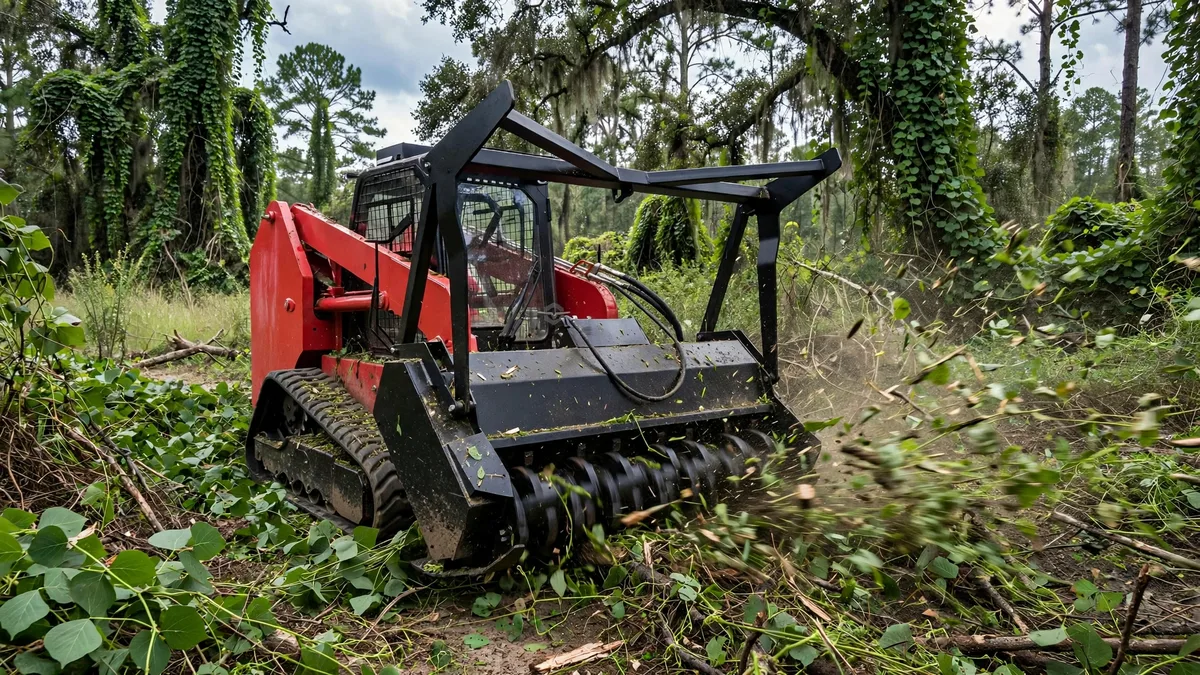
Forestry mulching. A tracked machine with a rotary mulching head grinds brush, saplings, and vines into mulch — in place, in a single pass. Standing vegetation goes in; a carpet of wood chips comes out. Advantages: extremely fast (acres per day), no hauling required, the mulch layer suppresses regrowth and enriches the soil as it decomposes, and the machine's low ground pressure minimizes soil disturbance. Best for: large areas of dense brush, acreage edges, lots where the mulch layer is an acceptable finished surface, and kudzu ground-cover clearing where the goal is suppression plus follow-up treatment.
Cut-and-haul. Crews cut brush with chainsaws and brush cutters, then chip or haul everything off-site — leaving bare, clean ground. Advantages: precise (we work around desirable trees and structures with surgical control), finished surface is immediately usable (sod-ready, build-ready), no mulch layer to manage. Best for: fence lines, areas around homes and structures, smaller lots, ditch banks where mulch would wash away, and selective clearing where preservation matters most.
Often, the answer is both: forestry mulching for the dense interior acreage, cut-and-haul along the edges, structures, and specimen trees. During your free estimate, we'll walk the property and recommend the right combination — and explain why.
What about the trees worth saving? Selective clearing is our default. Before any machine starts, we mark desirable trees — mature oaks, magnolias, healthy pines, dogwoods — and the clearing plan works around them. Many clients are surprised how good their property looks when the junk is gone and the good trees can breathe: more light, more air circulation, and healthier trees overall.
Brush Clearing vs. Land Clearing: Which Do You Need?
These are related but distinct services, and choosing correctly saves you money:
Brush clearing (this page) = removing undergrowth, vines, saplings, and invasive plants from a property while generally preserving the existing tree canopy and land contours. The land's fundamental character doesn't change — it just gets reclaimed from overgrowth. Typical jobs: fence lines, ditch banks, neglected lots, kudzu-choked acreage, understory cleanup.
Land clearing = full site preparation — removing trees, stumps, and vegetation to create buildable or usable open ground. Grading implications, stump excavation, complete transformation. Typical jobs: new construction sites, pasture creation, commercial development.
The gray zone: clearing a heavily wooded lot for a homesite often involves both — brush clearing first (understory and invasives), then selective tree removal of unwanted canopy trees, then stump grinding where structures will sit. We'll scope the full sequence in one estimate so you're not hiring three contractors.
When in doubt, describe your end goal during the estimate — "I want my backyard back" versus "I want to build a shop here" — and we'll recommend the right service.
Our 5-Step Clearing Process
1. Property walkthrough. We walk the entire area with you — free. You point out priorities (the fence line, the ditch, the kudzu patch swallowing the shed); we identify invasive species, mark desirable trees for preservation, note access points for equipment, and flag complications (wet areas, steep slopes, buried utilities).
2. Method and plan. You receive a written plan: clearing method per zone (mulching vs. cut-and-haul), preservation list, debris disposition, itemized pricing, and realistic timeline. For kudzu, the plan includes the follow-up treatment schedule — not just the initial clearing.
3. Clearing execution. Crews and equipment go to work. Desirable trees are flagged and protected; invasive root crowns are targeted (not just top-cut); debris is mulched in place or hauled per the plan. We work systematically so nothing is missed and nothing preserved gets damaged.
4. Detail finishing. Edges are defined, stumps from cleared saplings are cut flush or ground per your preference, and the entire area is raked clean. This is the step that separates professional clearing from "a guy with a bush hog" — the finished product looks intentional.
5. Follow-up plan (kudzu and aggressive invasives). For kudzu, privet, and wisteria, we schedule follow-up visits to treat regrowth — because the first clearing is the beginning of control, not the end. We'll explain the expected timeline and cost during the estimate so there are no surprises.
Reclaim Your Property — Get a Free Estimate
That overgrown lot, that kudzu-choked fence line, that jungle of a backyard — it's all fixable. Let's walk it together and make a plan.
Call +1 (647) 367-1424 for a free on-site brush clearing estimate anywhere in the Jackson metro, or request an estimate online. We'll identify what's growing, mark what's worth saving, and give you honest pricing — including a realistic kudzu control timeline.
Call Now: +1 (647) 367-1424 WhatsApp [Get Free Estimate]
Jackson Tree Pros — Tree service in Jackson, MS clearing brush and kudzu across Hinds, Rankin, and Madison counties.
Frequently Asked Questions
Will the kudzu come back after you clear it?
Honestly: it will try. Kudzu's underground root crowns survive cutting and resprout — that's just biology. Our kudzu jobs include a follow-up treatment plan targeting regrowth until the root crowns are exhausted, which typically takes multiple growing seasons. What we promise: a clear property now, and a managed plan that wins the war over time. What no honest company promises: one visit, gone forever.
Can you save my trees that are already covered in kudzu?
Sometimes. If the tree's canopy is partially engulfed but the trunk is sound, carefully cutting and removing vines (without damaging bark) plus follow-up treatment can save it. If kudzu has fully smothered the canopy for multiple seasons, the tree is likely already dead or structurally ruined — we'll assess honestly and recommend removal only if the tree can't recover. The sooner we get the vines off, the better the odds.
How much does brush clearing cost in Jackson, MS?
Light brush clearing is priced per acre; dense, kudzu-choked, or difficult-access ground is priced per acre. Small jobs (fence lines, ditch banks) are priced per linear foot or per job. Kudzu projects are quoted per project including the follow-up plan. Every estimate is free and itemized.
Do you use herbicides?
When appropriate and with your approval — targeted application to cut stumps and regrowth is often the most effective tool against privet, kudzu, and wisteria root crowns. We apply selectively (not broadcast spraying), follow label directions, and explain exactly what's being used and why. If you prefer a chemical-free approach, we'll design a mechanical-only plan with adjusted expectations and pricing.
What happens to all the debris?
Forestry mulching leaves it as beneficial mulch on-site. Cut-and-haul jobs: brush chipped on-site or hauled away — your choice, priced in the estimate. Usable logs can be left as firewood. Nothing is left piled, burned, or curbside.
Can you clear around my septic system or well?
Yes, with care. We map septic tanks, drain fields, and wells during the walkthrough and use low-impact methods near them — no heavy equipment over drain fields, no deep stump excavation near tanks. Tell us where everything is (or we'll help you figure it out) and the plan routes around it.
How long does a typical clearing job take?
Fence lines and small lots: a day. Multi-acre brush clearing: 1–3 days with mulching equipment. Kudzu initial clearing: depends on infestation size — most residential kudzu projects complete the first clearing in 1–2 days, with follow-up visits scheduled across the growing season.