Call +1 (647) 367-1424 WhatsApp Get a Free Estimate
Free On-Site Assessments • Serving Greater Jackson
What Are Tree Cabling & Bracing?
Cabling and bracing are structural support systems — essentially orthopedics for trees. They're used to hold together a tree that is otherwise healthy but has a mechanical weak point that could fail in a storm.
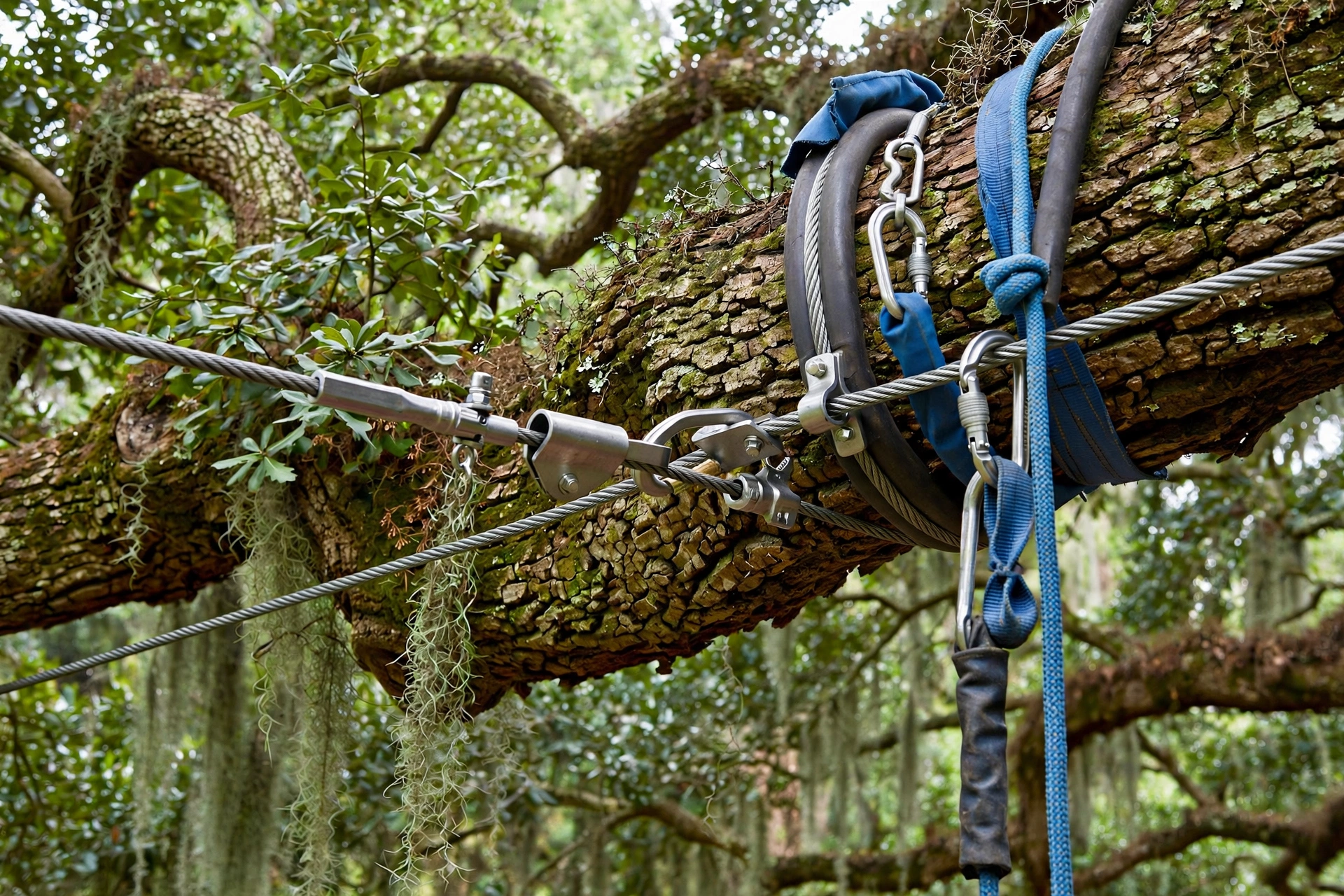
Cabling means installing high-strength steel cables in the upper canopy, connecting major limbs to each other or back to the main trunk. The cables don't hold the limbs up like a sling — they limit how far limbs can move in high wind, so a weak union never takes the full force of a gust on its own. Think of it as a seatbelt, not a crutch.
Bracing means installing threaded steel rods directly through a trunk or limb — typically where a split or crack has already started. The rod is bolted on both sides, clamping the two halves together so the split can't widen. Cables and braces are often installed together: the brace holds the existing crack, the cable prevents future movement from reopening it.
There are two approaches. Static systems use rigid steel cable — the traditional choice for serious structural defects, and what we install for most at-risk mature trees. Dynamic systems use flexible synthetic materials that allow more natural movement; they're suited to younger trees or lighter defects. We'll recommend whichever fits your tree — not the most expensive option.
One thing cabling and bracing are not: a cure. These systems support living wood. They can't save a tree that's dead, extensively decayed, or rotting from the roots up. If your tree is beyond help, we'll tell you — and explain why tree removal is the safer call.
Signs Your Tree Needs Structural Support
Not every big tree needs hardware. But certain defects are red flags — especially in the Jackson metro, where hurricane-season winds and saturated Yazoo clay put extra stress on already-weak unions. Here's what we look for during an assessment:
V-shaped co-dominant trunks. When two trunks grow upward at a sharp V from the same point, the union is inherently weak — bark gets trapped inside the joint ("included bark") instead of wood fusing solidly. Live oaks and water oaks in Madison and Ridgeland develop these constantly, and it's the most common reason we install cables.
Visible cracks or splits. A crack running down a trunk or along a major limb is a structural failure in progress. Small, stable cracks in sound wood are braceable. Cracks that are widening, weeping, or accompanied by decay are a different conversation.
A heavy limb over your roof, driveway, or play area. The defect might be minor — but the consequence of failure is major. We weigh both. A weak limb over an open field can be monitored; the same limb over bedrooms gets hardware or comes down.
Previous storm damage. A limb that partially tore in a past storm and "healed" is never as strong as it was. Old wounds, stub cuts from bad pruning jobs, and lightning scars all create lasting weak points — and Mississippi's storm frequency means most mature trees carry some history.
A mature tree developing a new lean. Some lean is natural. A tree that starts leaning — especially after extended heavy rain on Yazoo clay — may have root or soil issues hardware alone can't fix. We'll assess the root zone first; bracing a tree with failing roots is money wasted, and we'll say so.
If you're seeing any of these, don't wait for the next storm to test the tree. Our tree health specialists can assess the full picture — structure, health, and soil — in one visit.
Cabling vs. Removal: How We Decide
This is the honest part, and it's why homeowners in Madison and Ridgeland call us about their heritage oaks: sometimes the right answer is a $1,000 support system, and sometimes it's removal. Here's exactly how we make the call.
We recommend cabling and bracing when: the tree is otherwise healthy and vigorous; the defect is specific and correctable (a V-union, a single split, one overweighted limb); the tree has real value — shade, beauty, property value — that justifies the investment; and the risk after installation drops to an acceptable level. A 60-year-old live oak shading a Madison backyard is the textbook candidate.
We recommend removal when: there's extensive internal decay (hardware can't hold rotted wood); the root system is compromised; more than roughly a third of the canopy is gone or dead; the lean toward a structure is progressing; or the support system would cost nearly as much as removal while leaving a compromised tree. Then tree removal is the responsible call, and we'll explain why.
What we will never do: sell hardware for a tree we wouldn't trust ourselves. If we install it, it's because we believe in the outcome — and we'll put the reasoning in writing with your quote.
In many cases, we pair cabling with targeted tree trimming — selectively reducing the weight on the supported limb so the hardware carries less load. The combination is stronger than either treatment alone.
Have a valuable tree with a structural defect? Get a free on-site assessment — we'll tell you honestly whether support or removal is the right call. Call +1 (647) 367-1424.
How Much Does Tree Cabling & Bracing Cost in Jackson, MS?
| System | Typical range in Jackson, MS |
|---|---|
| Single cable installation | Quoted per job |
| Multiple cables (2–3) | Quoted per job |
| Bracing rod(s) | Quoted per job |
| Combined cable + brace system | Quoted per job |
| Annual follow-up inspection | Quoted per job |
What drives the price: the tree's height and spread (bigger canopy = more cable, more climbing), how many limbs need support, whether both cabling and bracing are required, and access — a backyard oak with no equipment access costs more in labor than a front-yard tree we can reach easily.
For perspective: supporting a mature oak typically costs a fraction of removing one. Full removal of a large oak near a structure — sectional dismantling, hauling, stump grinding — runs into the thousands. When the tree is worth saving, hardware is usually the economical choice too.
Every quote is free, written, and itemized — you'll see exactly what hardware goes where and why before you commit.
Protecting Heritage Oaks in Madison, Ridgeland & the Jackson Metro
Some trees are worth more than the lumber. The mature live oaks shading Madison's established neighborhoods and the hardwoods along the Natchez Trace corridor in Ridgeland took decades to grow — and they add measurable value to the properties beneath them. That's exactly who cabling and bracing is for.
We work regularly in the metro's preservation-minded communities:
- Tree service in Madison, MS — heritage oaks, HOA neighborhoods, and specimen trees worth protecting
- Tree service in Ridgeland, MS — Trace-corridor canopy and mature hardwoods
- Tree service in Brandon, MS — established lots with aging shade trees
Cabling and bracing is one part of our complete tree service in Jackson, MS, alongside health care, pruning, and — when it's honestly the safer choice — removal. One call covers the full assessment.
Lightning Protection for Valuable Trees
Mississippi's storm country produces intense lightning, and a strike on a mature oak is devastating: the bolt superheats the tree's internal moisture, blowing bark off in strips, splitting the trunk, and often killing the tree outright — sometimes weeks after the strike, as the damaged tissue fails. A lightning-scarred tree is also structurally compromised, which is why strike damage shows up in our structural assessments alongside cracks and splits.
Lightning protection systems exist for high-value specimen trees — typically a copper conductor run from the upper canopy down the trunk to a grounding rod, giving the strike a controlled path to earth instead of through the living wood. They're the same principle as lightning rods on buildings, adapted for trees.
Who's a candidate? Heritage oaks and specimen trees where the tree's value justifies the investment — the same Madison and Ridgeland legacy trees we cable and brace. No system can guarantee a tree survives a direct strike; what protection does is meaningfully shift the odds. During a tree risk assessment, we'll tell you honestly whether your tree is a good candidate or whether the money is better spent elsewhere.
Save Your Tree Before the Next Storm
That split trunk won't fix itself — and hurricane season won't wait. If you have a valuable tree with a structural defect anywhere in the Jackson metro, get a professional assessment now, while there's time to act.
Call +1 (647) 367-1424 for a free on-site evaluation, or request your estimate online. We'll give you a straight answer: support it, or remove it — and exactly why.
Call Now: +1 (647) 367-1424 WhatsApp Request Free Estimate
Jackson Tree Pros — Structural tree support for the Greater Jackson, Mississippi area.
Frequently Asked Questions
Will cabling actually save my tree?
Cabling doesn't heal defects — it manages them. For a healthy tree with a specific structural weakness (a V-shaped union, a single crack, an overweighted limb), a properly installed system significantly reduces failure risk and can add many years to the tree's life. It won't save a tree that's decaying, diseased beyond treatment, or failing at the roots. That's why the assessment comes first.
How long does the hardware last?
Steel cable and rod systems typically last many years — often a decade or more — but they're not install-and-forget. Hardware should be inspected annually for tension, wear, and corrosion, and to confirm the tree hasn't grown around fittings problematically. We'll give you the inspection schedule for your installation.
Does cabling or bracing harm the tree?
Any drilling creates a wound, which is why hardware only goes where the benefit clearly outweighs it. We use proper techniques — correctly sized holes, no over-tightening — and trees compartmentalize small, clean wounds well. An unnecessary installation harms more than a necessary one, which is why we assess honestly first.
How much does tree cabling cost in Jackson, MS?
A single cable installation is priced by tree size and access, while a combined cable-and-brace system for a large oak costs more — every system quoted in writing before work begins. The exact price depends on tree size, the number of limbs involved, and access. Free written estimates — call {{PHONE}}.
Does a cabled tree need ongoing maintenance?
Yes — plan on an annual inspection, which we can perform. We check cable tension, hardware condition, and whether the tree's growth requires adjustment. We may also recommend light follow-up pruning every few years to keep weight balanced. It's a small recurring cost that protects your original investment.
Can lightning protection save my tree from a strike?
It significantly improves the odds but can't guarantee survival — a direct strike carries enormous energy, and no system controls all of it. Protection gives the bolt a low-resistance path to ground instead of through living wood, which is what causes the explosive bark-stripping damage. It's worth considering for irreplaceable heritage trees; for ordinary trees, the investment rarely pencils out.
My tree was struck by lightning last year and looks okay. Is it fine?
Not necessarily. Strike damage often kills tissue internally while the canopy looks normal — decline can show up months later as dieback, bark shedding, or new cracks. Have it assessed: a lightning-scarred trunk is a structural weak point, and it may now be a candidate for cabling, monitoring, or removal depending on what the assessment finds.