Call +1 (647) 367-1424 WhatsApp [Get a Free Assessment]
Free On-Site Assessment • Written Treatment Plan • Serving Greater Jackson
Tree Health Assessment: What's Included
Every treatment plan starts with a proper diagnosis — guessing wastes your money and can kill the tree faster. Here's what happens when we visit your property:
Full walkthrough. We inspect each tree you're concerned about from roots to crown: the trunk for cracks, cavities, and fungal bodies; the canopy for dieback, discoloration, and thinning; and the root flare for girdling roots, soil heaving, or buried flare — one of the most common and most missed problems we see.
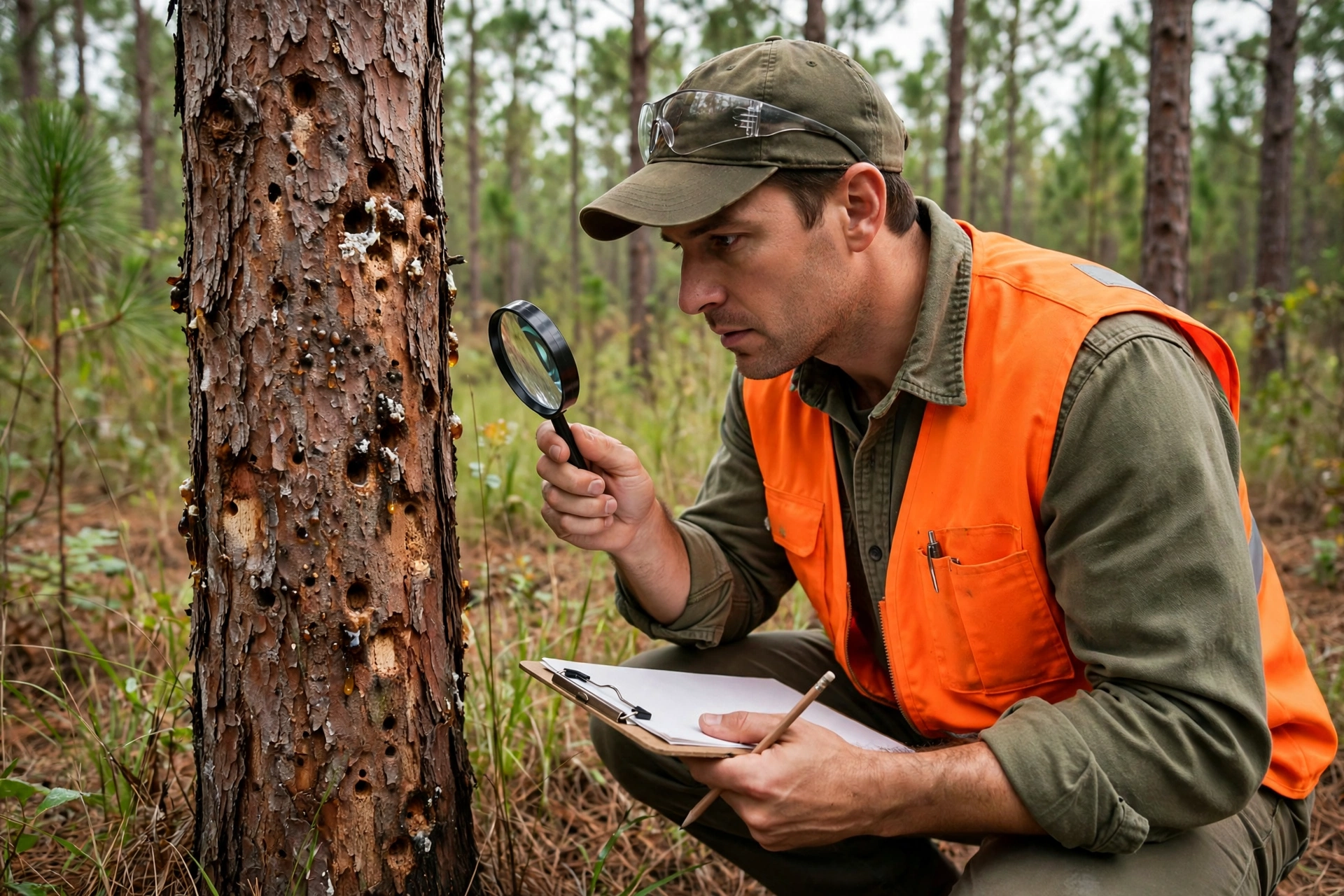
Pest and disease identification. We look for the specific signatures of Mississippi's worst offenders: pitch tubes and boring dust (southern pine beetle), felt-like patches on bark (crape myrtle bark scale), bark sloughing with dark mats beneath (hypoxylon canker), and leaf patterns that point to oak wilt or nutrient deficiency.
Site evaluation. Trees don't get sick in a vacuum. We check drainage, soil compaction (Jackson's Yazoo clay compacts into near-concrete), recent construction damage to root zones, and mower or string-trimmer wounds at the base. Half the "disease" calls we get turn out to be site problems — which is good news, because site problems are fixable.
Written plan with options. You get our findings in plain English, ranked by priority: what needs treatment now, what to monitor, what pruning can correct, and what — if anything — should come down. The assessment is free, and there's no obligation to proceed.
Common Tree Diseases & Pests in Mississippi
Mississippi's heat, humidity, and heavy clay soils create ideal conditions for tree pests and disease. These are the five problems we diagnose most often in the Jackson metro — what they look like, and what we do about each. For a deeper dive, see our guide to southern pine beetle and oak wilt in Mississippi.
Southern Pine Beetle
The southern pine beetle is Mississippi's most destructive forest pest, and it doesn't stay in the forest — suburban pines in Brandon, Florence, and Byram are hit regularly. Look for popcorn-sized pitch tubes on the bark, reddish boring dust in bark crevices, and crowns fading from green to yellow to brown. A heavily infested pine can die within weeks during warm weather, and beetles spread to neighboring pines fast.
What we do: confirm the diagnosis first, because several problems mimic beetle damage. Light, early infestations sometimes respond to treatment. Heavy infestations don't — and then fast removal is the responsible move, because a dead infested pine becomes a beetle factory that threatens every pine on your street. Prevention matters too: stressed pines attract beetles, so thinning crowded stands and watering during droughts genuinely reduces your risk. The Mississippi Forestry Commission tracks outbreaks statewide — if beetles are active in your county, don't wait to get your pines checked.
Oak Wilt
Oak wilt is a fungal disease that kills live oaks and red oaks, and it spreads two ways: through fresh pruning wounds in spring, when beetles carry spores from tree to tree, and underground through grafted root systems connecting neighboring oaks. Warning signs include leaves browning from the edges inward and rapid canopy decline in spring or early summer.
What we do: accurate diagnosis first — oak wilt gets blamed for problems it didn't cause. For high-value trees, options include therapeutic treatments and root-graft disruption to stop underground spread between trees. But the most important thing we do is preventive: we prune oaks in late fall and winter, never in spring, and we sterilize equipment between trees. One spring pruning cut on an infected neighboring tree is all it takes to start an outbreak on your property.
Hypoxylon Canker
Hypoxylon is a stress disease — the fungus lives harmlessly in oak bark until drought, construction damage, or other stress weakens the tree, then it attacks. You'll see bark sloughing off in patches, revealing black or dark-brown mats underneath, usually starting in the upper trunk and branches. It shows up most often after Mississippi's drought summers.
Here's the honest truth: once hypoxylon is widespread through the canopy, the tree typically can't be saved — no treatment reverses it at that stage. If we catch it early in a small area, we focus on rebuilding the tree's vigor with water, mulch, and soil care, and we monitor closely. If it's advanced, we recommend safe removal before a weakened tree becomes a hazard. We'd rather give you that straight answer than sell you treatments that won't work.
Crape Myrtle Bark Scale
This relatively new pest is spreading fast through Mississippi landscapes. Signs: white or gray felt-like patches on the bark, black sooty mold coating leaves and bark below, and declining blooms. The scale insects suck sap and excrete honeydew, which grows the sooty mold.
The good news: infested crape myrtles almost always recover fully with proper treatment. We use dormant-season horticultural oil and systemic insecticides timed to the scale's life cycle, then clean up the sooty mold. It's one of the most satisfying fixes we do — trees that looked half-dead in spring are blooming normally by summer.
Nutrient Deficiency in Clay Soils
Jackson's Yazoo clay is dense, compacts easily, and locks up nutrients that trees need. Classic signs: yellowing leaves with green veins (iron chlorosis — common in pin oaks and magnolias here), stunted new growth, thin canopies, and dieback at branch tips. Surface fertilizer usually doesn't fix it, because compacted clay blocks uptake at the roots.
What we do: soil testing first, so we treat the actual deficiency instead of guessing. Then deep-root fertilization — injecting nutrients directly into the root zone under pressure, bypassing the compacted surface layer — combined with mulch and soil aeration to fix the underlying compaction. Healthy soil grows healthy trees. Everything else we do builds on this foundation.
Our Plant Health Care Programs
A one-time treatment fixes today's problem. A program prevents next year's. Our seasonal plant health care plans bundle the ongoing work your trees actually need in central Mississippi:
What's included: deep-root fertilization timed for spring and fall uptake, systemic insect treatments scheduled around pest life cycles (not sprayed blindly), disease monitoring visits where we catch problems early, mulch refresh and soil care, and a pre-storm-season check that flags weak limbs before hurricane season.
Built around your property, not a template. A heritage live oak in Madison gets a preservation-focused plan. A pine stand on acreage in Florence gets beetle monitoring and thinning guidance. Newly planted trees get establishment care — the first three years determine whether a tree thrives or merely survives. Commercial properties get scheduled service that keeps the landscape presentable without you thinking about it.
How it works: we assess your trees, propose a seasonal plan with clear pricing, and schedule the visits. After each visit you get a short written report — what we did, what we found, what's coming next. Plan members get priority scheduling, which matters most in the two weeks after a major storm when everyone is calling at once.
When Treatment Works — and When Removal Is Safer
We make money treating trees, so it would be easy to recommend treatment for everything. We don't. Here's how we think about it:
Treatment is the right call when the problem is caught early, the tree is structurally sound, and the species responds to treatment. Bark scale on crape myrtles, early nutrient deficiency, minor pest pressure on an otherwise vigorous tree — these are wins waiting to happen.
Removal is the right call when the tree is a structural risk no treatment can fix: advanced hypoxylon, heavy pine beetle kill, major root damage, deep trunk cavities, or a lean that keeps getting worse. A treated tree that's still going to fail is just a more expensive hazard. In those cases we'll recommend tree removal in Jackson, MS and explain exactly why — and we'll put it in writing.
Our rule is simple: we'd rather keep your trust for twenty years than sell you a treatment that won't work. If you're unsure which side of the line your tree falls on, that's exactly what the free assessment is for.
Not sure whether your tree can be saved? Call +1 (647) 367-1424 — we'll come look and give you a straight answer.
Get a Free Tree Health Assessment
Yellowing leaves? Dying branches? Bark that doesn't look right? Don't guess — get a diagnosis.
Call +1 (647) 367-1424 — our tree health specialists will assess your trees, explain what's happening in plain English, and give you a written plan with upfront pricing. Free assessment, no obligation, no pressure.
Call Now: +1 (647) 367-1424 WhatsApp Request Free Assessment
Jackson Tree Pros — tree service in Jackson, MS. Professional tree health care for the Greater Jackson, Mississippi area.
Frequently Asked Questions
Can a sick tree be saved?
Sometimes — it depends on the diagnosis, how far the problem has progressed, and the species. Bark scale, nutrient deficiencies, and early pest issues usually respond well to treatment. Advanced pine beetle kill or widespread hypoxylon typically don't. Our free assessment gives you an honest answer before you spend anything.
How much does tree health treatment cost in Jackson, MS?
Single treatments are priced per tree depending on size and method. Seasonal health care programs are generally priced per year based on the number of trees and services included. The on-site assessment and written plan are always free.
Are your treatments safe for kids and pets?
We select products with household safety in mind and apply everything according to label directions, including posted re-entry times for treated areas. Tell us about kids, pets, vegetable gardens, or pollinator plantings during the assessment and we'll tailor the approach — there is almost always a safe option.
How often do trees need treatment?
It depends on the tree and the problem. Fertilization is typically annual or twice yearly. Insect treatments follow pest life cycles — sometimes once a season, sometimes a short series. Program members get everything scheduled automatically, with a report after each visit.
Do you treat southern pine beetle infestations?
Early, light infestations sometimes respond to treatment. But once beetles have heavily colonized a pine, removal is the responsible choice — a dead infested tree breeds beetles that attack neighboring pines. Speed matters enormously with this pest: call at the first sign of pitch tubes, not after the crown turns brown.
Is the assessment really free?
Yes. We visit, inspect your trees, evaluate the site, and give you written findings with prioritized options — at no charge and with no obligation. Most assessments are scheduled within a few days of your call.