Call +1 (647) 367-1424 WhatsApp [Schedule an Assessment]
Free On-Site Estimates • Honest Recommendations • Serving Hinds, Rankin & Madison Counties
Is Your Tree a Risk?
Most hazardous trees give warning signs long before they fail. Homeowners in Jackson often notice something "off" about a tree but aren't sure whether it's serious. Here are the signs that warrant a professional assessment:
- New or increasing lean. A tree that has started leaning — especially after heavy rain in Jackson's Yazoo clay soil — may have compromised roots. Sudden lean is urgent; gradual lean deserves evaluation.
- Dead limbs in the canopy. Deadwood ("widowmakers") breaks off unpredictably, particularly in wind. A few dead branches are normal; extensive dieback is not.
- Cracks, splits, or cavities in the trunk. Vertical cracks, lightning scars that never closed, and hollow areas all reduce structural strength.
- Fungal fruiting bodies. Mushrooms or shelf fungi growing on the trunk or at the base (root flare) indicate internal decay — the wood is rotting even if the canopy still looks green.
- Root damage. Construction trenching, grade changes, soil compaction, or severed roots within the past few years destabilize the whole tree. Common in newer Brandon and Flowood subdivisions.
- Previous storm damage. A pine that lost major limbs in last year's storm, or an oak with a torn-out leader, may be structurally compromised even if it "looked fine" afterward.
- Two trunks joining in a tight V. Co-dominant stems with included bark are a classic split waiting to happen — especially in mature water oaks and Bradford pears.
If you recognize any of these, don't guess. Review our guide to signs your tree needs removal, then schedule an assessment — knowing the actual risk level is far cheaper than dealing with a failure.
What a Professional Tree Risk Assessment Includes
A proper assessment is systematic, not a glance from the driveway. Here's what our trained professionals evaluate:
Visual crown inspection. We examine the canopy from the ground (and closer when needed) for deadwood, dieback patterns, weak branch attachments, previous topping damage, and signs of pest or disease stress — including southern pine beetle indicators on pines and canopy thinning on oaks.
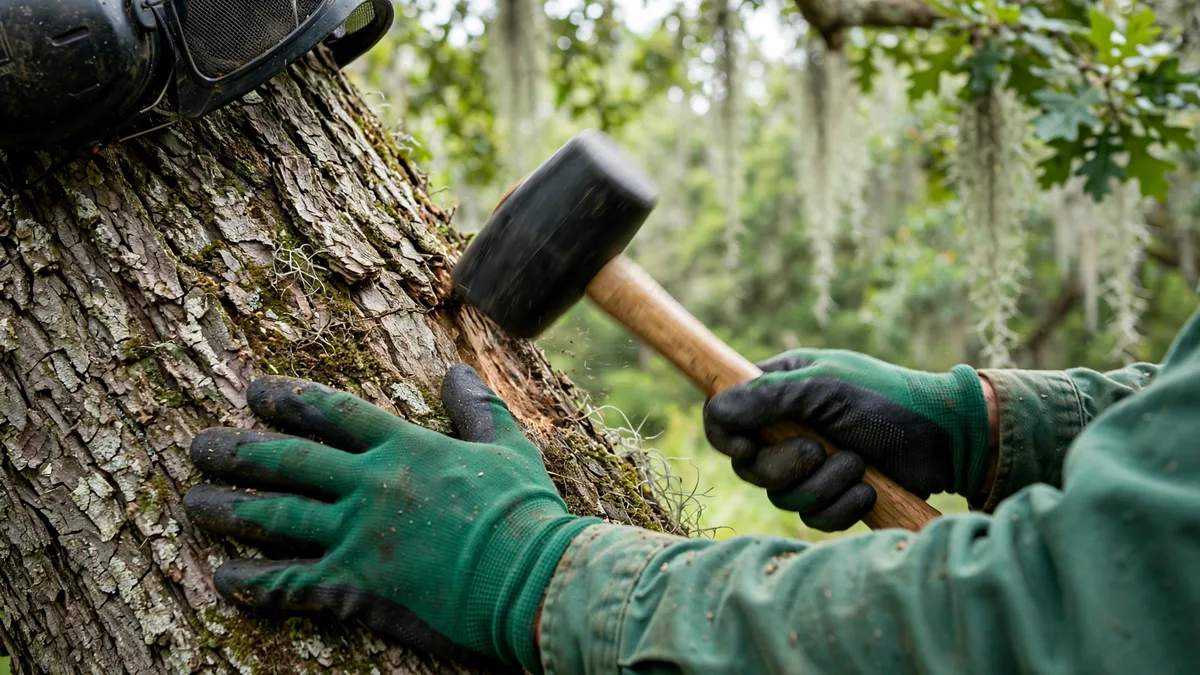
Trunk and structural defect check. The trunk is inspected for cracks, seams, cavities, decay pockets, fungal fruiting bodies, lightning damage, and co-dominant stems. We sound the trunk (tapping to detect hollow areas) and probe suspicious spots to gauge decay extent.
Root zone and site evaluation. What happens below ground determines stability above it. We check the root flare for girdling roots, fungal growth, and buried flare (a common planting mistake); look for heaving soil, exposed roots, and construction damage; and assess Jackson's notorious Yazoo clay conditions — saturated clay after heavy rain is when root failures happen.
Decay indicators. Beyond visible fungi, we look for carpenter ant activity, woodpecker damage (which often targets decayed wood), conks, and resin flow patterns that signal internal problems.
Target analysis. Risk isn't just about the tree — it's about what the tree could hit. We identify "targets": your house, roof, driveway, power lines, fences, play areas, neighboring properties, and high-traffic zones. A hazardous tree in an empty back corner is a different situation than the same tree leaning over a bedroom.
Written findings. You receive a plain-language summary: what we found, the risk level (see below), and recommended actions in priority order — with honest guidance on whether the tree can be managed or should come down.
Common High-Risk Tree Situations in Jackson, MS
Certain scenarios come up again and again in the Jackson metro:
Storm-weakened pines. Tall loblolly pines are everywhere in central Mississippi — and they're brittle. A pine that survived a storm with a cracked trunk or partially uprooted root plate may stand for months before failing. After any major wind event, pines near homes deserve inspection.
Aging water oaks. Water oaks are fast-growing, weak-wooded, and relatively short-lived. Mature water oaks across Jackson's older neighborhoods develop internal decay while looking healthy from the street. They're one of our most common removal recommendations after assessment.
Trees over roofs and driveways. Any large tree with structural defects becomes high-priority when the target is your home. We assess dozens of "the big oak over the garage" situations every year — many are manageable with pruning or cabling and bracing; some need to come down.
Construction-damaged roots. New driveways, additions, utility trenches, and grading all sever roots. The damage often doesn't show for 2–5 years — then the canopy thins and the tree declines. If construction happened near a mature tree, an assessment catches the decline early when treatment can still help.
Lightning-struck trees. Mississippi's storm country means frequent lightning. A strike may kill a strip of bark (visible) while cooking the cambium beneath (invisible). Struck trees need evaluation — some recover, some become hazards.
Risk Levels Explained
We rate trees in plain language so you can make an informed decision:
- Low risk. The tree is structurally sound with no significant defects. Routine maintenance — pruning on a normal cycle — is all it needs. Most healthy, well-placed trees land here.
- Moderate risk. Defects exist but are manageable: some deadwood, minor decay, or a structural issue that pruning or cabling can address. We recommend specific corrective work and re-inspection on a schedule.
- High risk. Significant structural problems — extensive decay, major cracks, root compromise — with a valuable target underneath. Corrective action is needed promptly: often tree removal, sometimes major structural pruning. We'll explain exactly why.
- Extreme risk. Imminent failure potential — severe lean with root lifting, massive trunk failure, or a dead tree over a structure. This tree needs immediate attention. If it can wait for a scheduled crew, we'll say so; if it needs emergency tree service, we'll tell you that directly.
The rating always comes with the reasoning behind it — never just a verdict. You'll understand what we found and why it matters.
What Happens After the Assessment
An assessment is only useful if it leads to the right action. Depending on what we find, the recommendation typically falls into one of these paths:
Pruning and corrective care. Many moderate-risk trees just need professional work: deadwood removal, weight reduction on heavy limbs, clearance pruning away from the roof, or structural pruning to fix poor branch architecture. See our tree trimming service for details.
Cabling and bracing. Trees with co-dominant stems, splits, or heavy limbs over structures can often be preserved with steel support systems. It's a fraction of removal cost and keeps a valuable mature tree. Learn more about cabling and bracing.
Health treatment. If the risk driver is disease or pest stress — pine beetle activity, root-zone compaction, nutrient deficiency — a treatment plan through our tree health care program may restore stability.
Removal. When structural failure risk outweighs what treatment or support can safely manage, we'll recommend removal — and explain exactly why. We never recommend removal to sell a bigger job; our reputation depends on honest assessments. See tree removal for how the process works.
Monitor and re-inspect. Some trees warrant watchful waiting: minor defects, early-stage issues, or post-treatment recovery. We'll tell you what to watch for and when to have us back.
Every recommendation comes with priority and timing guidance — what needs attention now, what can wait for the dormant season, and what's simply worth monitoring.
Our 5-Step Assessment Process
1. Your call and description. Tell us what concerns you — the lean, the dead limbs, the fungus at the base. We'll ask a few questions (species if you know it, recent storms or construction, what's underneath it) and schedule a visit.
2. On-site inspection. Our professional walks the property with you, examining the tree from root flare to canopy top: trunk sounding, defect mapping, root-zone evaluation, and target analysis. We encourage you to walk along — you'll learn what we're seeing as we see it.
3. Risk rating. We assign a plain-language risk level (low, moderate, high, extreme) and explain the reasoning — which defects drive the rating and what could change it.
4. Written recommendations. You receive prioritized, priced options: corrective work, treatment, monitoring, or removal. Each option includes what it solves and what it costs.
5. Your decision, no pressure. Take the report, think it over, get a second opinion if you like. We charge a modest assessment fee, credited toward your project if you proceed — many clients find the assessment pays for itself in avoided surprises.
Schedule Your Tree Risk Assessment
Worried about a leaning pine, a cracked oak, or a tree that's just not looking right? Get answers from trained professionals — not guesses.
Call +1 (647) 367-1424 to schedule your assessment anywhere in the Jackson metro, or request an appointment online. We'll inspect your trees, explain exactly what we find, and recommend only what they actually need.
Call Now: +1 (647) 367-1424 WhatsApp [Schedule Assessment]
Jackson Tree Pros — Tree service in Jackson, MS serving Hinds, Rankin, and Madison counties with honest tree risk assessments.
Frequently Asked Questions
How much does a tree risk assessment cost in Jackson, MS?
A professional assessment for one to three trees is priced depending on tree size, number of trees, and property complexity. Whole-property inventories for large lots or commercial sites are quoted per visit. The written report and recommendations are included — you're paying for answers, not a sales pitch.
How long does an assessment take?
Most single-tree assessments take 30–60 minutes on site, including the walkthrough with you. Multi-tree or commercial property inventories take longer — we'll give you a time estimate when scheduling.
Do I need to be home during the assessment?
We prefer it — walking the property with you lets us show you exactly what we're seeing and answer questions on the spot. But if you can't be there, we can assess accessible trees and email the written report with photos. Just make sure gates are unlocked and dogs are secured.
Will you just try to sell me a removal?
No — and this matters to us. Our assessors are not paid commission on removals. A large share of assessments conclude with pruning, cabling, treatment, or monitoring recommendations. We recommend removal only when the structural evidence supports it, and we show you that evidence. An honest "this tree is fine" costs us a removal job today and earns us a customer for life.
Can I use your assessment report for insurance purposes?
Yes. Our written reports document tree condition, defects found, risk level, and recommendations with dated photos — exactly the kind of documentation insurers and property managers need. If a tree fails after we've documented it as high-risk, that paper trail supports your claim. (We document condition; coverage decisions are your insurer's.)
What's the difference between a risk assessment and a free estimate?
A free estimate prices a specific job you've already decided on ("remove this tree, how much?"). A risk assessment answers the question before the job: is this tree actually dangerous, and what's the right action? If you already know you want a tree removed, skip the assessment and request a removal estimate. If you're unsure what the tree needs, the assessment is the right starting point.
How often should mature trees be assessed?
We recommend professional assessment every 3–5 years for mature trees near structures, after any major storm, and after nearby construction. Trees with known defects under monitoring should be re-checked on the schedule in your report — typically annually.