Call +1 (647) 367-1424 WhatsApp Get a Free Estimate
Right Tree, Right Place • Serving Greater Jackson
The Best Trees to Plant in Central Mississippi
Jackson sits in USDA Zone 8 — brutal summers, mild winters, heavy clay soil, regular storms. These six species are proven in exactly these conditions. Here are the ones we plant most — and recommend most.
Live Oak
The signature Southern shade tree. Mature size: 60–80 feet tall with a canopy that can exceed 100 feet wide — a legacy tree, not a foundation planting. Live oaks tolerate Yazoo clay well once established and shrug off wind better than almost any large species; their low, spreading form is naturally storm-resistant. They're evergreen, so the shade is year-round. Needs: full sun and space. Don't plant one 10 feet from your driveway unless you enjoy lifting concrete.
Southern Magnolia
Mississippi's state tree. Mature size: 60–80 feet tall, 30–40 feet wide, evergreen with fragrant white blooms in late spring. Magnolias handle clay and heat without complaint, and the dense canopy makes an excellent privacy screen. The trade-off: year-round leaf and cone drop, so keep it away from pool decks. Needs: full sun to part shade, room for surface roots.
Bald Cypress
Got a low spot that stays wet? Plant a bald cypress instead of fighting it. Mature size: 50–70 feet. This native thrives in standing water and soggy clay where other trees drown — ideal near the Pearl River, reservoir-adjacent lots in Ridgeland, or any poorly drained yard. Note: it's a deciduous conifer, so it drops its needles every fall. That's normal, not disease. Needs: full sun, tolerates wet to average soil.
Crape Myrtle
The South's favorite ornamental — blooms, not bulk. Mature size: 15–25 feet depending on variety, which makes it ideal near homes, driveways, and under power lines where an oak would be a disaster. Summer flower clusters in white, pink, red, or purple, plus attractive winter bark. Needs: full sun (6+ hours), well-drained soil. And never "top" one — proper late-winter pruning keeps its natural form; topping ruins it permanently.
Pecan
A Mississippi native and a working tree: shade plus harvest. Mature size: 70–100 feet — an acreage tree, not a suburban-lot tree. Needs cross-pollination (two compatible varieties for real nut production) and deep, well-drained soil. For Florence/Byram properties with room, few trees pay back like a pecan. Needs: full sun, lots of space, patience.
Native Dogwood
For smaller lots and shady spots. Mature size: 15–30 feet — a true understory tree. Spring blooms, red fall color, berries birds love. Wants part shade (afternoon shade is ideal in our summers) and consistent moisture while young. Needs: part shade, steady water for the first couple of summers.
Not sure which fits your property? That's what the free consultation is for — we'll match species to your soil, space, sunlight, and goals.
Right Tree, Right Place
Most of the tree problems we get called about 15 years later were planting mistakes on day one. Placement matters as much as species.
Distance from your house and foundation. Plant at least half the tree's mature canopy spread from any structure — 20–30 feet minimum for large shade trees. In Yazoo clay this matters doubly: large roots near foundations interact with the same soil movement that already stresses Jackson foundations. Good shade cools your house; bad placement cracks your slab.
Overhead power lines. Look up before you dig. If lines cross the area, the tree's mature height must stay well clear — small trees only (crape myrtle, dogwood) under lines, never oaks or pecans. When in doubt, call your utility company; we'd rather help you pick a different spot than watch you fight the power company for 20 years.
Septic systems and drain fields. Roots seek water, and drain fields are an all-you-can-eat buffet. Keep thirsty, aggressive-rooted species well away from septic tanks and drain lines. On rural properties around Florence and Byram where septic is the norm, we map the system before picking a single planting spot — root intrusion into a drain field is a five-figure repair; planning is free.
Underground utilities. Same principle below ground: before any digging, we call 811 to mark utility lines. It's free, it's the law, and it takes one phone call.
Our Tree Planting Process
- Site assessment. We walk your property and evaluate soil and drainage, sunlight patterns, existing trees, structures, and utilities — and ask what you want the tree to do: shade the west wall, screen the neighbors, produce pecans, or just look beautiful.
- Species selection. Based on the assessment, we recommend 2–3 species with honest pros and cons. You choose; we advise. No upselling you into a specimen tree your lot can't support.
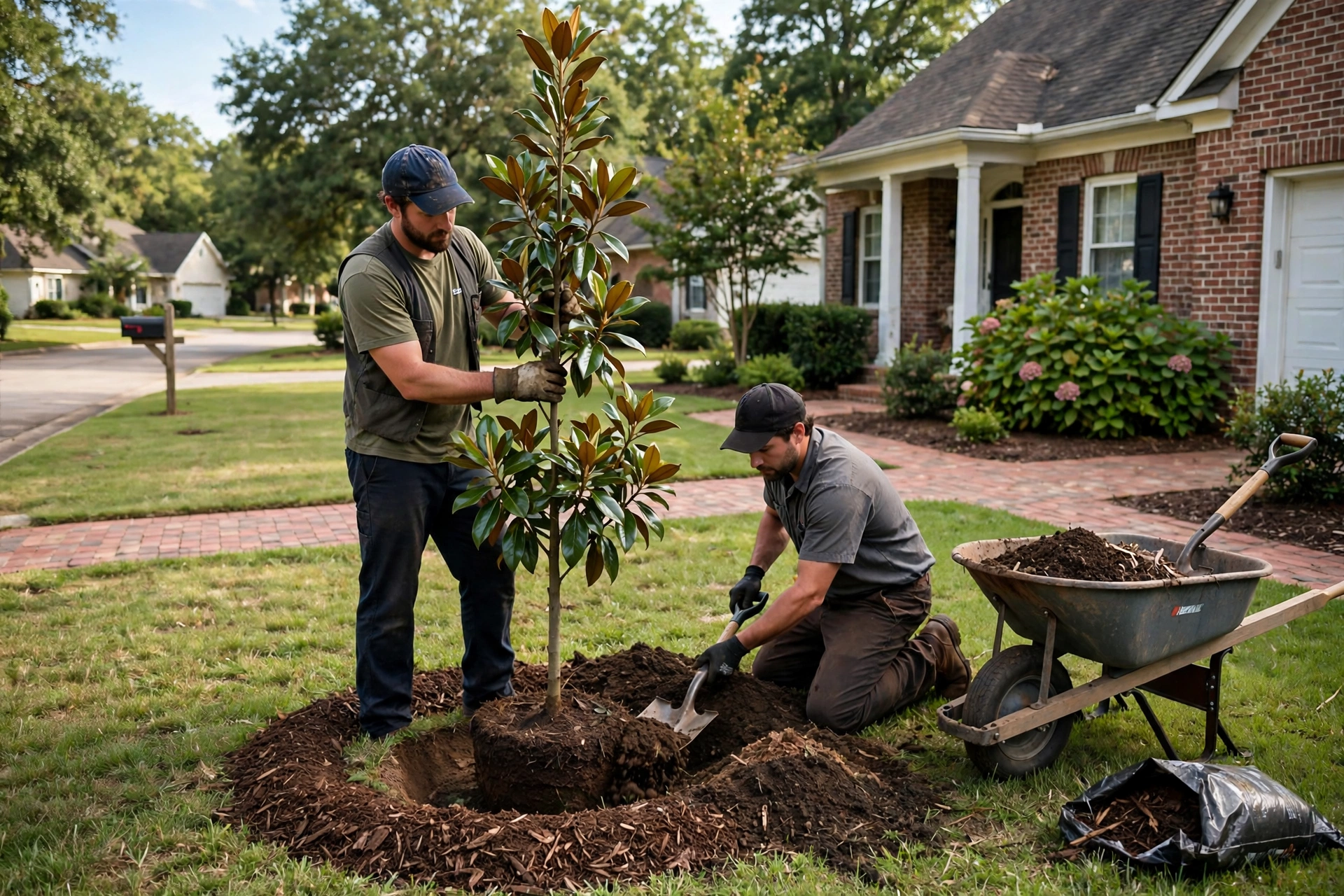
- Proper planting depth — the step everyone gets wrong. The number one killer of newly planted trees is planting too deep. We set every tree so the root flare — where the trunk widens at the base — sits at or slightly above finished grade. Buried flares suffocate roots and rot trunks.
- Mulching. A 2–3 inch layer of mulch in a wide ring, kept pulled back from the trunk. It retains moisture, moderates soil temperature, and keeps mowers away from young bark. What we never do: "volcano mulching" against the trunk. It causes rot.
- Watering plan. We leave you with a specific schedule, not vague advice. New trees in Mississippi need deep, consistent watering through their first two growing seasons — especially through our summers. Exactly how much, how often, and how to adjust for rain.
Planting this fall or winter? That's the ideal window — book your free consultation now before the season fills up. Call +1 (647) 367-1424.
How Much Does Tree Planting Cost in Jackson, MS?
| Tree size | Typical range |
|---|---|
| Small container tree (3–7 gallon) | Quoted per job |
| Medium tree (15 gallon) | Quoted per job |
| Large balled-and-burlapped tree | Quoted per job |
| Multiple-tree / landscape planting | Discounted per-tree pricing — ask |
What affects the price: species and nursery size, site preparation, quantity (five trees cost less per tree than one), and whether old stumps or debris need clearing first.
Bigger isn't always better. Smaller container trees are cheaper, establish more easily, and often outgrow larger transplants within a few years thanks to less transplant shock. We'll give you the honest trade-off — not just the premium option.
Every planting quote is free and includes species recommendations, a placement plan, and the watering schedule. No surprises.
Tree Planting Across the Jackson Metro
We plant across Hinds, Rankin, and Madison counties:
- Tree service in Madison, MS — new-construction landscaping and specimen trees
- Tree service in Flowood, MS — landscape plantings for fast-growing subdivisions
- Tree service in Florence, MS — acreage plantings, windbreaks, and pecan groves
Planting is part of our complete tree service in Jackson, MS. Once your trees are in the ground, our tree health specialists keep them thriving — and our tree trimming crews handle structural pruning as young trees mature.
Call 811 Before You Dig
Before any shovel hits the ground — planting, stump work, or landscaping — call Mississippi 811. It's the state's free "call before you dig" service: you request a locate, utility companies mark their buried gas, electric, water, and telecom lines with paint or flags, and then you dig with confidence. In Mississippi, requesting a locate before digging is the law, not a courtesy — and a planting hole or stump grinder can absolutely reach buried lines.
Call a few business days before your project so locators have time to respond. The marks are free, the call is free, and the alternative — severing a gas line or your neighbor's fiber — is catastrophically expensive. When we handle your planting, we place the 811 request as part of the job. If you're digging on your own for any reason, make the call yourself first.
Protecting Trees During Construction
Some of our saddest removal calls start with: "We built the house three years ago, and now the oak is dying." Construction kills mature trees slowly — grading changes suffocate roots, trenching severs them, and heavy equipment compacts the soil they breathe through. The tree looks fine for a year or two, then declines.
The fix is planning, not luck. Before grading starts: fence the critical root zone (at minimum, the tree's drip line — further is better), route trenches and driveways around major roots, prohibit equipment parking and material storage under canopies, and avoid raising or lowering the grade around the trunk. After construction: deep watering through the first dry seasons and a health check for stress signs.
If you're clearing a lot for new construction, see our land clearing service — we plan clearing and preservation together, so the specimen trees worth keeping survive the build.
Plant It Right the First Time
A tree is a 50-year decision. The difference between a thriving shade tree and a struggling one comes down to three things: the right species, the right spot, and the right planting depth. We get all three right, across the Jackson metro, every week.
Call +1 (647) 367-1424 for a free planting consultation, or request your estimate online. Fall planting season fills fast — reach out early.
Call Now: +1 (647) 367-1424 WhatsApp Request Free Estimate
Jackson Tree Pros — Professional tree planting for the Greater Jackson, Mississippi area.
Frequently Asked Questions
When is the best time to plant trees in Mississippi?
Fall through winter — roughly October through February. Cool-season planting lets trees focus on root establishment without summer heat stress, so they enter spring already anchored. Spring works too, but gives less establishment time before July and August. Avoid mid-summer unless you can commit to rigorous watering.
How far from my house should I plant a tree?
At least half the tree's mature canopy spread — 20–30 feet minimum for large shade trees like live oaks and pecans. In Yazoo clay, extra distance is cheap insurance against root/foundation interaction and saves you years of pruning limbs off your roofline.
What trees grow best in Mississippi clay soil?
Live oak, southern magnolia, bald cypress (especially wet spots), and pecan handle clay well once established; crape myrtle and dogwood do fine with decent drainage. Species matters less than technique, though — proper depth, a wide hole with loosened sides, and mulch. Even the right tree fails planted too deep in compacted clay.
Do you guarantee newly planted trees?
We stand behind our workmanship — correct depth, proper mulching, and a clear watering plan on every job. Ask about current warranty terms during your free consultation; details depend on species and size. What no one can warranty is neglect: a tree that never gets watered in August is beyond anyone's guarantee.
How much water does a newly planted tree need?
Deep watering 2–3 times per week through the first two growing seasons, adjusted for rainfall — Mississippi summers are brutal on establishing roots. We'll give you a specific schedule for your tree and soil. A soaker hose on a timer handles most situations; the trees that die are almost always the ones that dried out in July.
Do I really need to call 811 before planting a tree?
Yes — in Mississippi, requesting a utility locate before digging is required, and it's free. Planting holes, especially for larger balled-and-burlapped trees, go deep enough to reach buried gas, electric, and telecom lines. Call 811 a few business days before your project. When we do your planting, we handle the locate as part of the job.
We're building a new home. How do we keep our existing trees alive?
Bring us in before grading starts — that's the critical window. We set up protective fencing around the root zones of trees worth saving, plan trench and driveway routes around major roots, and specify no-equipment zones under canopies. Trees protected during construction usually thrive; trees "worked around" without protection typically decline within 2–5 years.