Call +1 (647) 367-1424 WhatsApp Get a Free Estimate
Free Estimates • Full Cleanup • Serving Greater Jackson
Stump Grinding vs. Full Stump Removal: Which Do You Need?
Most Jackson homeowners need grinding, not excavation. Here's the honest difference:
| Stump Grinding | Full Stump Removal (Excavation) | |
|---|---|---|
| What happens | A grinder chews the stump into chips, 6–12" below grade | The entire stump and root ball are dug or pulled out |
| Typical cost | Quoted per stump | Quoted per stump |
| Time on site | 30–60 minutes per stump | Half day or more; heavy equipment |
| Damage to yard | Minimal — one small work area | Large hole; tears up surrounding lawn |
| Best for | Lawns, landscaping beds, anywhere you want a clean finish fast | New construction, foundations, or replanting a large tree in the exact same spot |
Our recommendation: grinding is the right call for about 9 out of 10 residential stumps in the Jackson metro. It's faster, cheaper, and your lawn recovers in weeks instead of months. Full excavation only makes sense when you're building something where the stump sits or planting a large replacement tree in precisely the same hole. We'll tell you which one you actually need during the free estimate — not upsell you into the bigger job.
If the stump is left over from a tree removal in Jackson, MS, bundling grinding with the removal is almost always cheaper than booking it as a separate visit. Ask about bundle pricing when you call.
Still weighing the two approaches? Read our full side-by-side breakdown: stump grinding vs. stump removal.
Why Remove That Stump? 5 Reasons Jackson Homeowners Call Us
Termites and carpenter ants love dead stumps. This is the big one in Mississippi. A decaying pine or oak stump is a five-star hotel for subterranean termites and carpenter ants — and once a colony is established in the stump, your house is the next stop. In a state where termite pressure is year-round, leaving a rotting stump 20 feet from your foundation is asking for trouble.
Stumps don't stay dead — they sprout. Sweetgums, Bradford pears, and crape myrtles are notorious for sending up suckers from the stump and roots for years after the tree is cut. You'll be fighting a hydra of weak shoots every mowing season unless the stump is ground out.
They destroy mowers and hurt people. Every landscaper in Rankin County has a story about a hidden stump and a $200 mower blade. Stumps are also a genuine tripping hazard — especially for kids and older family members.
They're ugly and they take up space. A stump in the middle of your lawn dictates your whole mowing pattern and landscaping plan. Grind it, and you get your yard back.
They attract fungi and decay. Mushrooms fruiting around a stump mean active rot — and some of those fungi spread to nearby healthy trees through root contact.
Stumps Attract Termites in Mississippi — What to Do About It
Mississippi has some of the heaviest subterranean termite pressure in the country, and a decaying stump is the perfect nursery: soft, moist wood, sheltered from sun, sitting right in the soil. Once a colony establishes in the stump, foraging tunnels can extend 100+ feet — which puts your foundation, fence posts, and deck squarely in range.
Signs termites have already found your stump: mud tubes climbing the bark, small piles of wings (swarmers) nearby in spring, wood that sounds hollow when tapped, or soil packed into cracks in the stump. If you see any of these, the stump has gone from "unsightly" to "active risk."
Grinding beats treating. You can have a stump chemically treated, but treatment only poisons what's there — the dead wood remains, and new colonies can move in later. Grinding removes the food source entirely. No stump, no colony, no re-infestation. For general termite guidance, the MSU Extension Service publishes homeowner resources on subterranean termite identification and prevention — worth a read if you're seeing swarmers around your property.
Bottom line: in termite country, stump grinding isn't cosmetic work. It's pest prevention. The sooner the stump is gone, the smaller the window for a colony to bridge from yard to house.
Our Stump Grinding Process: What to Expect
- Free estimate, honest quote. We measure the stump's diameter, check access for the grinder, note any complications (rocks, slope, nearby utilities), and give you an upfront price. Multiple stumps? We discount per stump as the count goes up.
- We call 811 before we grind. Mississippi law requires utility locates before any digging — and a stump grinder cuts 6–12 inches into the ground, which is deep enough to hit gas, electric, or irrigation lines. We call Mississippi 811 and wait for the all-clear. Any company that skips this step is gambling with your property.
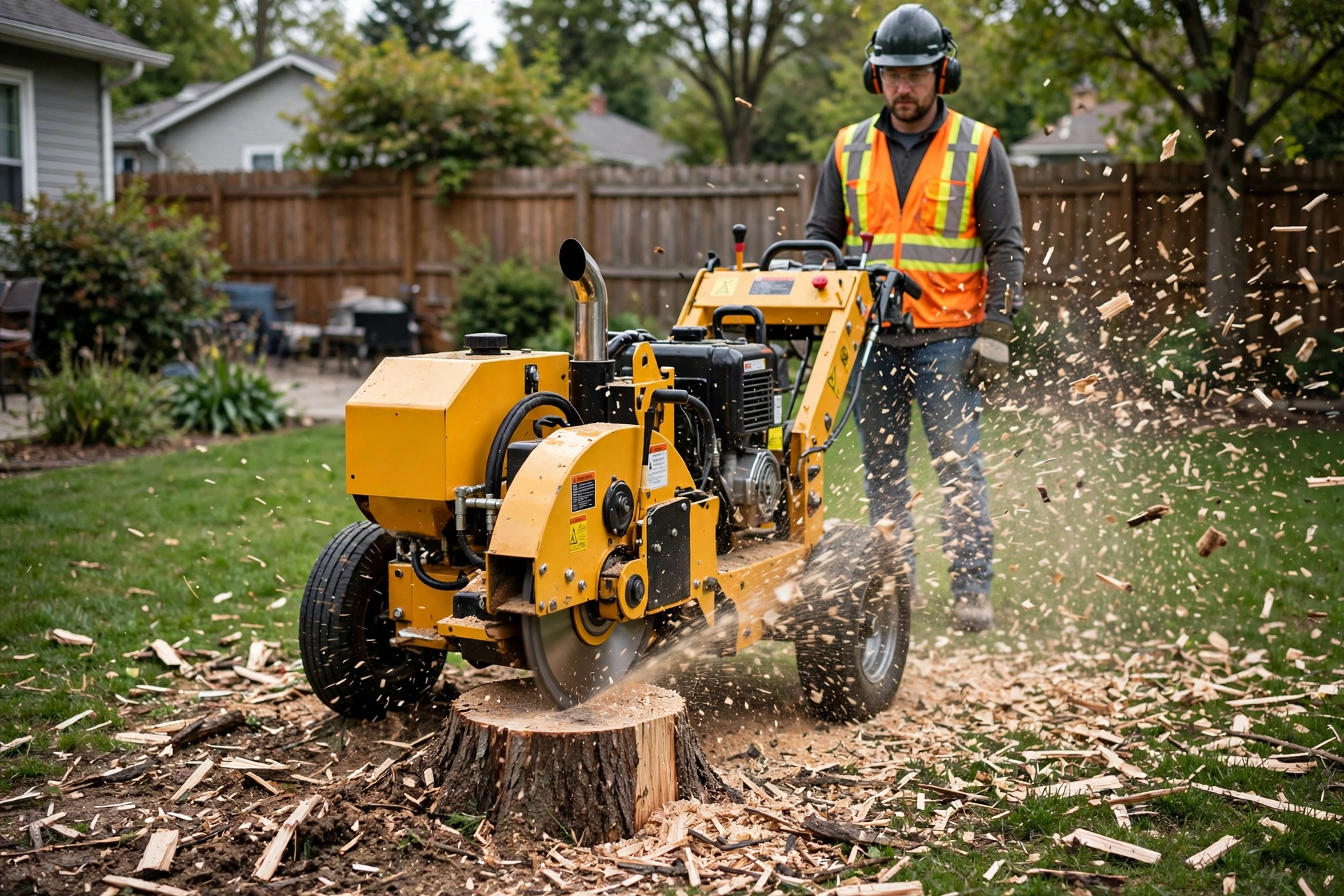
- Grinding day. Our crew positions the grinder, clears the work zone, and grinds the stump down 6–12 inches below grade, sweeping side to side until the visible stump and major surface roots are gone. Most single stumps take 30–60 minutes.
- Chips: your choice. We can haul the wood chips away, or spread them as mulch in your beds — fresh chips make excellent mulch once they age a few months. Your call.
- Backfill and cleanup. We backfill the depression with the grindings/soil mix, rake the area level, and clean up. The spot will settle slightly over a few weeks as the material compacts — that's normal, and we can top it off if needed.
Stump Grinding Cost in Jackson, MS
Pricing is driven mainly by stump diameter (measured at ground level) and access. Here's the typical range:
| Stump diameter | Typical range |
|---|---|
| Small (under 12") | Quoted per stump |
| Medium (12–24") | Quoted per stump |
| Large (24–36") | Quoted per stump |
| Extra-large (36"+, mature oak/pine) | Quoted per stump |
| Each additional stump (same visit) | Discounted per stump |
What raises the price: poor access (grinder can't get the machine close), rocky soil, stumps tangled with old fencing or concrete, and hardwood species like live oak that grind slower than pine. What lowers it: bundling with a tree removal on the same visit, and multiple stumps in one trip — the crew is already there, so each extra stump costs less.
What Happens After Grinding? Replanting, Sod, and Timing
Can I plant a new tree where the stump was? You can plant grass or small shrubs almost immediately. For a new tree in the exact same spot, wait 6–12 months — the old root system is still decomposing underground, and it will rob a young tree of nitrogen as it breaks down. Planting a few feet to the side works fine right away. If you're planning new plantings, see our tree planting service in Jackson, MS — we'll match species to your soil and goals.
Can I lay sod over it? Yes. We backfill and level the area, and once it settles (a few weeks), it's ready for sod or seed. In Jackson's climate, sod laid in spring or fall establishes fastest.
Will the stump grow back? No — not after proper grinding. Grinding destroys the growth tissue. You may see the backfilled area settle an inch or two as chips decompose; a quick top-off of topsoil fixes it.
What about the roots? Grinding removes the stump and major surface roots. Deeper roots stay underground and decompose naturally over a few years — they won't damage foundations or regrow.
Stump Grinding in Your Neighborhood
We grind stumps across the full Jackson metro — Brandon, Madison, Ridgeland, Clinton, Pearl, Flowood, Richland, Byram, and Florence. Pine stumps on acreage in Florence and Byram, oak stumps in Madison's established neighborhoods, Bradford pear stumps everywhere — we've ground them all.
As a local tree service in Jackson, MS, stump grinding is one of our most-booked services, and most jobs are done within a few days of your call.
Get Your Free Stump Grinding Estimate
That stump isn't getting smaller — but the termites finding it are getting closer. Get it ground, get your yard back.
Call +1 (647) 367-1424 — free on-site estimates, delivered promptly. Bundle with tree removal and save.
Call Now: +1 (647) 367-1424 WhatsApp Request Free Estimate
Jackson Tree Pros — Professional tree care for the Greater Jackson, Mississippi area.
Frequently Asked Questions
How much does stump grinding cost in Jackson, MS?
Single stumps are priced by diameter — call for a fast quote. Small stumps under 12 inches are cheapest; large oak or pine stumps over 36 inches cost more. Booking multiple stumps in one visit brings the per-stump price down, and bundling with a tree removal is the best value of all.
How deep do you grind the stump?
We grind 6–12 inches below grade as standard — deep enough that you can mow, landscape, or lay sod right over the spot. If you're building a structure or need deeper clearance, tell us during the estimate and we'll go deeper.
Will stump grinding damage my lawn or sprinklers?
The grinder works in a contained area around the stump, so lawn impact is minimal — far less than excavation. Before grinding, we call Mississippi 811 to locate buried utilities, and we ask you to flag sprinkler heads and invisible fence lines so we can work around them.
I have several stumps. Is there a discount?
Yes. The crew, truck, and grinder are already on site, so each additional stump costs significantly less than the first. Stumps left from storm damage or lot clearing are our most common multi-stump jobs — call {{PHONE}} for bundle pricing.
How long does stump grinding take?
A single average stump takes 30–60 minutes. Three or four stumps on one property usually fit in a half day. You'll have a firm time estimate before we start — most residential jobs are done in one visit.
Can termites spread from a stump to my house?
Yes — and in Mississippi, it's one of the most common ways subterranean termite colonies get established near homes. Foraging termites travel from the stump through soil tunnels to reach structural wood, sometimes 100 feet or more. Grinding the stump removes the colony's food source and home in one step, which is far more effective than treating the stump and leaving it in place.
I see mud tubes on my stump. Should I treat it or grind it?
Grind it. Treatment kills the current colony but leaves the decaying wood — an open invitation for the next colony. Grinding physically removes the food source, so there's nothing left to attract termites, carpenter ants, or wood-decay fungi. If you're seeing swarmers or mud tubes, schedule the grinding soon: an active stump colony next to your foundation is a problem that compounds with time.