Call +1 (647) 367-1424 WhatsApp Get a Free Estimate
Free On-Site Estimates • Full Cleanup Included
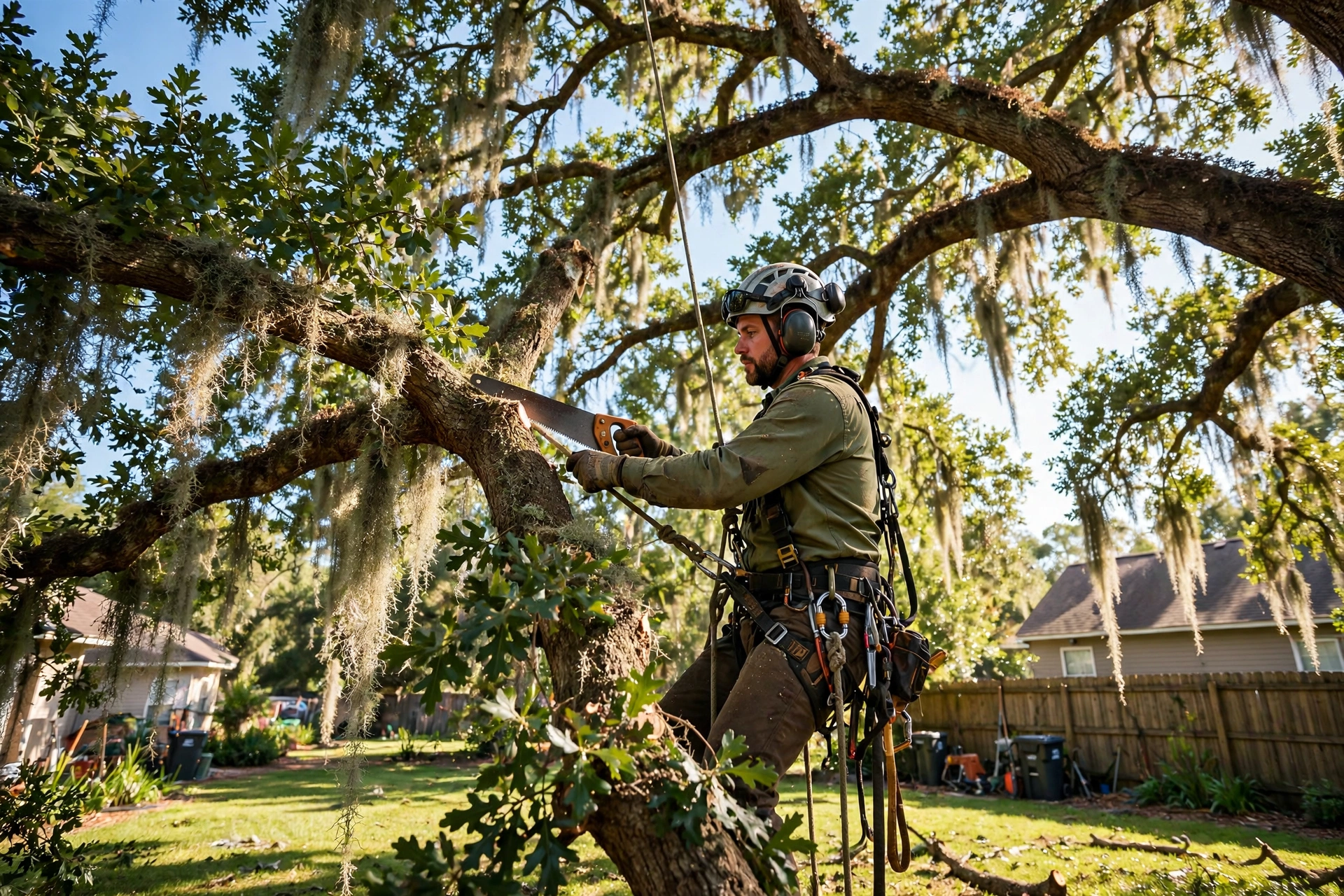
Types of Tree Pruning We Perform
"Trimming" covers several distinct techniques, and using the right one matters. Here's what we do and when each applies:
Crown Cleaning
Removal of dead, dying, diseased, and broken branches from the canopy. This is the baseline of good tree care — deadwood is where decay starts and where limbs break off in storms. If your oak is dropping dead branches on your lawn in Madison or your pine is shedding over your driveway in Brandon, crown cleaning is the starting point. We recommend it every 3–5 years for mature trees.
Crown Thinning
Selective removal of live branches to open the canopy and let wind pass through. This is hurricane-season insurance: a dense canopy catches wind like a sail, while a thinned canopy lets it flow through. Thinning also lets light reach your lawn and reduces weight on heavy limbs. We never remove more than about 25% of live foliage in a season — over-thinning starves the tree.
Crown Raising
Removing lower limbs to create clearance over driveways, sidewalks, roofs, and streets. If you're ducking under branches to get to your car in Ridgeland or limbs are scraping your roof in Clinton, raising solves it. We maintain proper proportions — never removing so much lower canopy that the tree becomes top-heavy.
Crown Reduction
Careful shortening of limbs to reduce a tree's overall size — used when a tree has outgrown its space near a house or structure. This is skilled work: proper reduction cuts back to lateral branches that can take over as leaders. It is not topping (see below). Reduction is often the alternative to removing a tree that's simply gotten too big for its spot.
Structural Pruning for Young Trees
The highest-value pruning you'll ever buy. Young trees pruned correctly in their first decade develop strong branch architecture that prevents the splits and failures we remove in mature trees. If you're in a new Flowood or Brandon subdivision with young street trees, structural pruning now prevents expensive problems in twenty years.
Not sure which your trees need? That's what the free assessment covers — we'll look at your trees and recommend only what's actually necessary. Call +1 (647) 367-1424.
Best Time to Trim Trees in Mississippi
Late winter — January through February — is the best time to trim most trees in Mississippi. Trees are dormant, branch structure is fully visible without leaves, pruning wounds heal quickly with spring growth, and most pests and diseases are inactive.
Species-specific timing matters here:
- Live oaks and red oaks: Prune in late winter and avoid spring pruning. Fresh spring wounds on oaks attract the beetles that spread oak wilt, a fungal disease that can kill a mature oak. This is the single most important timing rule for Jackson's oak canopy.
- Crape myrtles: Late winter, before new growth starts. And never "top" them — topping crape myrtles (the infamous "crape murder") destroys their natural form and produces weak, ugly regrowth. Proper pruning thins and shapes; it doesn't butcher.
- Southern magnolias: Light pruning in late winter or right after their spring bloom. Heavy pruning stresses them.
- Loblolly pines: Light pruning can be done most of the year, but avoid heavy work during peak southern pine beetle activity. If your pines show pitch tubes or fading crowns, call our tree health specialists — that may be a treatment-or-removal situation, not a pruning one.
- Flowering trees (dogwood, redbud): Prune right after blooming finishes, so you don't cut off next year's flowers.
When not to prune: during hurricane season, heavy pruning opens fresh wounds right when storms and disease pressure peak. Emergency broken-limb removal is always fine — routine shaping can wait for winter.
For the full month-by-month calendar, see our Mississippi tree pruning timing guide.
Trimming vs. Topping: Why Topping Destroys Trees
Topping — cutting a tree's crown back to stubs, usually to "make it smaller" — is the most damaging thing you can do to a tree short of killing it outright. Here's why no reputable tree service in Jackson does it:
It causes decay. The large stub wounds topping leaves behind can't seal properly. Decay moves straight into the trunk, hollowing the tree from the inside.
It produces weak, dangerous regrowth. The tree responds by sprouting dozens of fast-growing shoots from the cut points. These shoots grow quickly but attach weakly — within a few years you have a crown full of limbs more likely to break in storms than the original branches were.
It starves the tree. Removing most of the canopy removes most of the tree's food production. A topped tree is a stressed tree, and stressed trees attract pests and disease.
It creates liability. A topped tree with weak regrowth over your roof or driveway is a documented hazard. If it fails and damages property, the topping history works against you.
What to do instead: proper crown reduction (cutting back to healthy lateral branches), or if the tree is genuinely too large for its location, honest removal and replacement with a right-sized species. If a company offers to "top" your trees, that's your sign to call someone else.
How Much Does Tree Trimming Cost in Jackson, MS?
| Job | Typical range |
|---|---|
| Small ornamental tree (crape myrtle, dogwood) | Quoted per job |
| Medium tree (30–50 ft) | Quoted per job |
| Large mature tree (50+ ft oak or pine) | Quoted per job |
| Multi-tree / whole-property pruning | Quoted per job |
What affects your price:
- Size and number of trees. The two biggest cost drivers — bigger canopy, more time aloft.
- Access. A tree in an open yard is quick work. The same tree behind a fence with no equipment access takes longer.
- Condition. Deadwood-heavy canopies and storm-damaged trees take more time than routine maintenance pruning.
- Cleanup. We include full cleanup — chipping, hauling, raking — in every quote. Some competitors quote low and leave you the mess; compare accordingly.
Regular pruning every 3–5 years costs far less than the emergency removal of a neglected tree — and far less than a roof repair after a dead limb comes down in a storm.
Want an exact number for your trees? Call +1 (647) 367-1424 — free on-site estimates, promptly.
Signs Your Trees Need Trimming
- Dead branches in the canopy. Brittle, leafless limbs that snap easily. Deadwood is the first thing to come down in wind — get it out before storm season.
- Limbs touching your roof, siding, or gutters. Constant rubbing damages shingles and gives pests a bridge into your attic. Branches should clear your roof by several feet.
- Blocked sunlight. If your lawn is thinning out under a dense canopy or your garden isn't getting light, thinning opens things up for everything growing underneath.
- Storm-broken or hanging limbs. After any significant wind event, walk your property. Hanging broken limbs ("widowmakers") are urgent — if one threatens a structure or walkway, call our emergency service.
- Crossing or rubbing branches. Limbs grinding against each other create wounds that invite decay. Selective removal fixes the structure.
- Low limbs blocking driveways or walkways. Clearance pruning keeps daily life moving and keeps delivery trucks from pruning your trees for you.
- It's been more than 5 years. Mature trees on a 3–5 year pruning cycle stay healthier, safer, and cheaper to maintain than trees pruned once a decade in crisis mode.
Tree Trimming Across the Jackson Metro
As a full-service tree service in Jackson, MS, we prune trees throughout the metro:
- Tree service in Brandon, MS — Mature pines on older lots and young trees in new subdivisions needing structural pruning.
- Tree service in Madison, MS — Heritage live oaks and HOA-governed landscapes where proper pruning protects property values.
- Tree service in Ridgeland, MS — Dense canopy along the Natchez Trace corridor needing thinning and crown work.
- Tree service in Clinton, MS — Established neighborhoods with large mature trees due for maintenance cycles.
We also serve Pearl, Flowood, Richland, Byram, and Florence. Many customers combine trimming with cabling and bracing for at-risk limbs — one visit, complete structural care.
Tree Trimming Near Power Lines
Never trim a tree yourself anywhere near energized power lines — and never hire anyone who will. Contact with a live line can kill instantly, and in Mississippi, storm-season ER visits spike from exactly this kind of DIY work. This is a hard rule with no exceptions.
Here's how responsibility actually breaks down: your utility company maintains the lines themselves and the vegetation clearance around them. In our area, Entergy Mississippi runs an ongoing vegetation management program that trims trees along its rights-of-way on a cycle — if limbs are in direct contact with their lines, that's their work, not yours. What falls to you as the homeowner is everything on your side: the trees themselves, limbs approaching (but not touching) lines, and the service drop running from the pole to your house.
What we do: professional clearance pruning on your trees outside the utility's energized zone — shaping canopies away from lines, removing limbs that are growing toward them, and recommending right-sized replacement species (like crape myrtle or dogwood) where a large tree keeps fighting the wires. When a job spans both zones, we coordinate timing with the utility so their crew clears the lines first, then we finish the tree. Read our full breakdown: who trims trees near power lines in Mississippi.
Deadwooding, Crown Thinning & Crown Reduction: Quick Reference
These three terms show up in every serious tree-care conversation in Jackson — here's what each one means and when your tree needs it:
| Technique | What it is | Best for |
|---|---|---|
| Deadwooding | Removing dead, dying, and broken branches from the canopy | Every mature tree, every 3–5 years — the baseline of storm prep |
| Crown thinning | Selectively removing live branches to let wind and light through | Dense canopies, hurricane-season readiness, lawns starved of light |
| Crown reduction | Shortening limbs back to healthy laterals to shrink overall size | Trees outgrowing their space near homes — the professional alternative to topping |
Deadwooding is maintenance. Thinning is storm insurance. Reduction is problem-solving. A good pruning plan usually combines all three — and none of them should ever remove more than about 25% of a tree's live canopy in a single season.
Get Your Free Tree Trimming Estimate
Overgrown canopy? Dead limbs? Storm season coming? Regular pruning is the cheapest protection your trees — and your roof — can get.
Call +1 (647) 367-1424 for a free on-site estimate anywhere in the Jackson metro. We'll assess your trees, recommend only what they actually need, and give you an upfront written price. Free on-site estimates with no obligation.
Call Now: +1 (647) 367-1424 WhatsApp Request Free Estimate
Jackson Tree Pros — Professional tree trimming and pruning for the Greater Jackson, Mississippi area.
Frequently Asked Questions
When is the best time to trim trees in Mississippi?
Late winter (January–February) is ideal for most species — trees are dormant and wounds heal fast in spring. The key exception: avoid pruning oaks in spring, when fresh wounds attract the beetles that spread oak wilt. Crape myrtles are also pruned in late winter, never topped in summer.
How often should my trees be trimmed?
Most mature trees benefit from professional pruning every 3–5 years. Fast-growing species and trees near structures may need attention every 2–3 years. Young trees should get structural pruning in their first decade to develop strong branch architecture that prevents future failures.
Will trimming harm my tree?
Proper pruning improves tree health — it removes dead and diseased wood, improves air circulation, and reduces storm-failure risk. Harm comes from improper work: over-thinning (removing more than ~25% of live canopy), topping, or pruning at the wrong time. That's why technique and timing matter more than price.
Can you trim trees near power lines?
We trim everything outside the utility's clearance zone. Limbs in direct contact with energized lines are utility-company work — call your power company first, and we'll handle the rest of the tree and coordinate with them when a job spans both zones. Never attempt this yourself or hire someone who will.
How much does tree trimming cost?
In the Jackson area, pricing is per tree depending on size — small ornamentals at the low end, large mature oaks and pines at the high end. Multi-tree and whole-property jobs are priced per visit. Every quote includes full cleanup, and estimates are free.
Do you haul away the branches?
Yes. Every trimming job includes complete cleanup: branches chipped on-site, wood hauled away or cut for firewood at your preference, and the work area raked clean. The quote you approve covers all of it — no separate disposal fee appearing afterward.
Who is responsible for trimming trees near power lines in Mississippi?
The utility company handles vegetation in direct contact with its energized lines — in our area, that's Entergy Mississippi's vegetation management program. Homeowners are responsible for the trees themselves and for limbs approaching (but not touching) the lines. We prune everything outside the utility's clearance zone and coordinate with them when a job spans both. Never attempt line-adjacent trimming yourself.
What is deadwooding, and does my tree need it?
Deadwooding is the removal of dead, dying, and broken branches from a tree's canopy — and yes, virtually every mature tree needs it every 3–5 years. Dead limbs are the first to break in storms and the entry point for decay and disease. It's the highest-value pruning task for storm prep, and it's included in our standard crown-maintenance work.