Call +1 (647) 367-1424 WhatsApp Get a Free Estimate
Free On-Site Estimates • Full Cleanup Included • Serving Hinds, Rankin & Madison Counties
Why Jackson Trees Need Fertilization
Mississippi trees don't usually starve in the forest — but yard trees live in far harsher conditions than forest trees. Here's what works against your trees in the Jackson metro:
Yazoo clay. Jackson sits on the famous (and infamous) Yazoo clay — dense, heavy, expansive soil that compacts tightly, drains poorly, and locks nutrients away from roots. In wet periods it swells and suffocates roots; in dry spells it shrinks and cracks, tearing fine roots. Trees in Yazoo clay are chronically stressed, and stressed trees can't take up nutrients efficiently even when they're present.
Construction compaction. Most suburban lots in Brandon, Madison, and Flowood were graded by heavy equipment that compressed the soil to near-concrete density. Roots can't penetrate it, water can't drain through it, and the tree survives on a fraction of the root zone it needs.
Lawn competition. Your turf grass is a nutrient thief. Every fertilizer application aimed at the lawn feeds shallow grass roots first; the tree's deeper roots get leftovers. Mature trees competing with irrigated, fertilized lawns slowly decline — thinner canopies, smaller leaves, less vigor each year.
Urban stress load. Heat reflected off driveways and roofs, limited soil volume, string-trimmer damage, mulch volcanoes — yard trees endure stresses forest trees never face. Fertilization doesn't fix all of this, but it gives trees the nutritional resources to tolerate what they can't avoid.
The result: yellowing leaves, sparse canopies, dieback at the branch tips, and trees that decline a little more every year. Fertilization — done correctly — can help reverse that trajectory.
What Is Deep Root Fertilization?
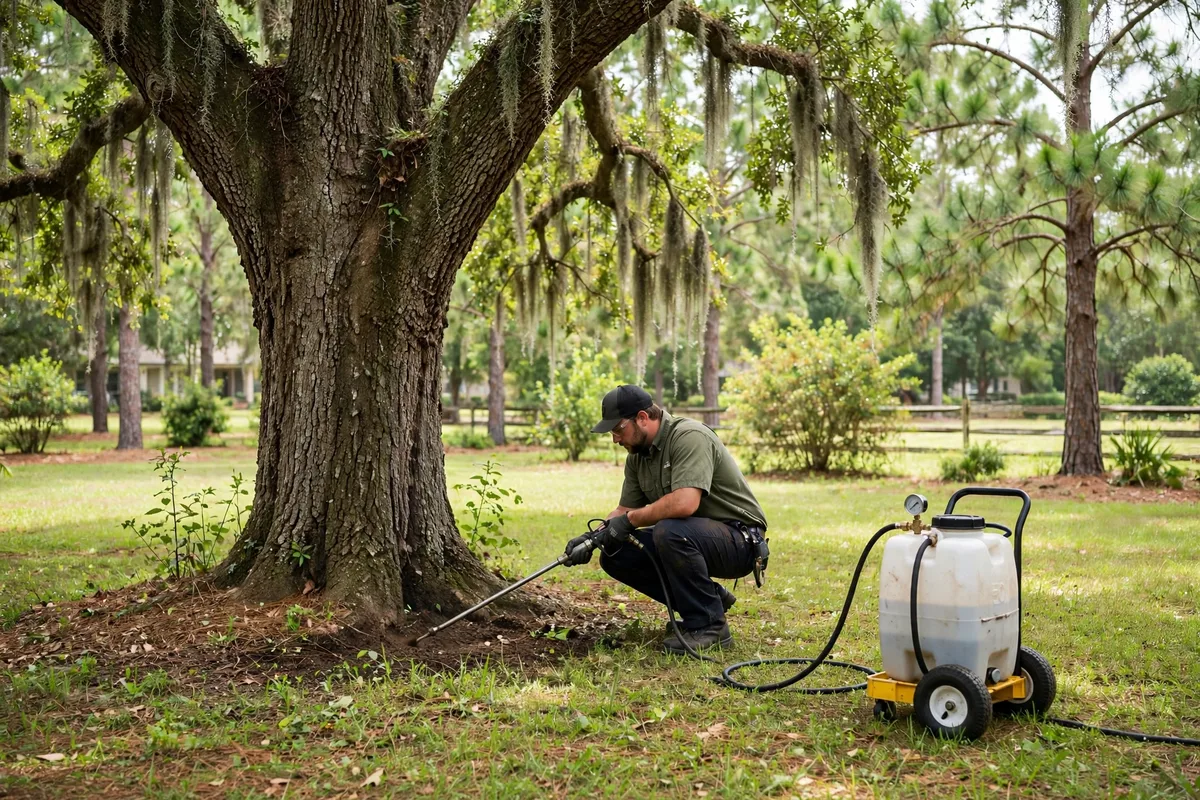
Deep root fertilization (often called deep root feeding) delivers liquid nutrients directly into the tree's root zone — typically 6 to 12 inches below the surface, where feeder roots actually live. Here's how it works:
Pressurized injection. A soil probe injects a nutrient solution under pressure at grid points throughout the root zone — usually starting a few feet from the trunk and extending out to (and beyond) the drip line, where most feeder roots are concentrated.
Why injection beats surface spreading. Broadcasting granular fertilizer on the lawn surface mostly feeds the grass. Injection places nutrients below the turf root zone, directly in contact with tree feeder roots — far less waste, far more uptake.
The aeration bonus. The injection process itself fractures compacted soil, creating channels that improve water penetration and gas exchange in dense clay. For trees suffocating in compacted Yazoo clay, this physical aeration effect can matter as much as the nutrients.
What's in the blend. Professional tree fertilizer blends typically balance nitrogen, phosphorus, and potassium with micronutrients trees commonly lack in urban soils — iron, manganese, zinc. Blends are adjusted to the species, the season, and what the soil assessment reveals. (Exact formulations vary; your technician will explain what's being applied and why.)
One important note: fertilization helps trees that are nutrient-stressed. It doesn't cure structural defects, advanced decay, or severe pest damage — those need tree health care diagnosis or, honestly, tree risk assessment first. A good provider tells you when feeding isn't the answer.
Signs Your Trees Need Feeding
Trees can't tell you they're hungry — but they show it:
- Yellowing leaves (chlorosis). Leaves that should be deep green turn pale or yellow, often with green veins — a classic micronutrient deficiency pattern, especially iron, in high-pH clay soils.
- Thinning canopy. Fewer, smaller leaves each season; you can see more sky through the crown than you used to.
- Slow or stunted growth. New twig growth noticeably shorter than in previous years; young trees that just sit there instead of establishing.
- Dieback. Branch tips dying back from the outer canopy inward — the tree is abandoning growth it can't support.
- Early fall color or leaf drop. Stressed trees shut down early; if your oak is dropping leaves weeks before its neighbors, it's struggling.
- Poor response to rain. A healthy tree rebounds after rain; a nutrient-depleted tree in compacted soil barely responds because its root system can't capitalize on the water.
One or two of these signs warrant a soil assessment. Several together — especially in a mature specimen tree you value — make a strong case for a feeding program.
Our Fertilization Program
We don't sell one-size-fits-all fertilizer applications. Our program follows the same diagnostic discipline as our tree health care work:
1. Soil and tree assessment. We evaluate the tree's condition, the soil texture and compaction, drainage patterns, and competing factors (lawn, construction history, mulch depth). This determines whether feeding is actually the right prescription — and what blend the tree needs.
2. Custom blend selection. Based on species, season, and soil findings, we select an appropriate nutrient formulation. Spring applications typically emphasize growth nutrients; fall applications focus on root development and winter hardiness.
3. Deep root injection. Our technician injects the blend on a grid across the root zone — out to and beyond the drip line — at the proper depth and spacing for the tree's size. The process takes 30–60 minutes per large tree.
4. Seasonal scheduling. Most Jackson-area trees benefit from feeding once or twice yearly: spring (as growth begins) and/or fall (supporting root growth through winter). Newly planted trees — see our tree planting service — get establishment feeding on a different schedule.
5. Annual program option. Program clients get scheduled visits, condition monitoring across seasons, and adjusted blends as the tree responds. Annual programs are priced depending on tree count and size — typically less per visit than one-off applications.
Every visit includes a quick canopy check — if we spot developing problems (pest activity, structural issues, disease signs), you'll hear about them. Fertilization visits double as early-warning inspections.
Trees That Benefit Most in Central Mississippi
Live oaks. Jackson's signature tree — massive, long-lived, and worth every penny of care. Mature live oaks in compacted urban soils respond well to deep root feeding, which supports the dense canopies that make them magnificent (and heavy).
Southern magnolias. Glossy and gorgeous when healthy; chlorotic and sparse when starved. Magnolias in clay soils frequently show micronutrient deficiencies that targeted feeding corrects.
Crape myrtles. Fast-growing and heavy-blooming — which means heavy-feeding. Properly fed crape myrtles (pruned correctly, never topped) bloom more profusely and resist bark scale pressure better. See our crape myrtle pruning guide for the pruning side of crape myrtle care, and our oak wilt and pine beetle guide for the disease threats Mississippi trees face.
Young pines in new subdivisions. Loblolly and slash pines planted as screening in new Brandon and Flowood developments often struggle in graded, compacted lots. Establishment feeding during the first few years dramatically improves survival and growth rates.
Recently transplanted trees. Any new planting — ours or yours — benefits from establishment feeding while roots colonize the surrounding soil. Ask about bundling feeding with tree planting.
Mature trees after construction. If grading, trenching, or additions happened near a valued tree in the last few years, feeding supports the root recovery the tree is attempting — alongside proper mulching and watering.
Get Your Free Fertilization Assessment
Yellowing leaves? Thinning canopy? A specimen oak that's lost its vigor? Let's find out what's happening below the surface.
Call +1 (647) 367-1424 for a free on-site fertilization assessment anywhere in the Jackson metro, or request an estimate online. We'll evaluate your soil, your trees, and give you an honest recommendation — including telling you when feeding isn't needed.
Call Now: +1 (647) 367-1424 WhatsApp [Get Free Assessment]
Jackson Tree Pros — Tree service in Jackson, MS helping Central Mississippi trees thrive in Yazoo clay.
Frequently Asked Questions
Is tree fertilization safe for my lawn, pets, and kids?
Yes, when applied professionally. Deep root injection places nutrients below the surface — not broadcast across the lawn where children and pets play. Once the application is complete and the surface water settles (usually within hours), the yard is usable normally. We'll give you specific after-care guidance for your situation.
How much does tree fertilization cost in Jackson, MS?
Per-tree deep root feeding is priced depending on tree size — small ornamentals at the low end, large mature oaks at the high end. Annual programs for multiple trees are priced per year and include scheduled visits plus condition monitoring. Every quote is free and written.
How often should my trees be fertilized?
Most established landscape trees in the Jackson area benefit from feeding once or twice per year — spring, fall, or both. Newly planted trees follow an establishment schedule (more frequent in year one, tapering off). Trees in severely compacted soil may need an initial corrective series. We'll recommend a schedule based on your soil assessment, not a generic calendar.
When is the best time to fertilize trees in Mississippi?
Spring (March–April, as buds break) and fall (October–November, supporting root growth) are the prime windows. Avoid heavy nitrogen applications in late summer — they push tender growth that winter cold can damage. Deep root injection can technically be performed most of the year, but we time applications for maximum uptake.
Do you offer organic fertilization options?
Yes — ask about organic and low-salt-index blend options during your assessment. Organic formulations release more slowly and build soil biology over time; conventional blends act faster. We'll explain the tradeoffs honestly and let you choose. Both are applied via the same deep root injection method.
How soon will I see results?
Set honest expectations: trees respond slowly. You may notice improved leaf color within one growing season; meaningful canopy thickening typically takes 1–2 full seasons of consistent feeding. Anyone promising a transformed tree in weeks is selling something else. Feeding is a long game — that's exactly why annual programs exist.
Can fertilization save a dying tree?
Sometimes — if the problem is nutritional. But decline has many causes: root damage, soil compaction, disease, pests, structural failure. That's why every program starts with assessment. If feeding isn't the answer, we'll tell you what is — whether that's health treatment, structural work, or honest advice that the tree can't be saved.