Last updated: September 21, 2026
What Is Stump Grinding?
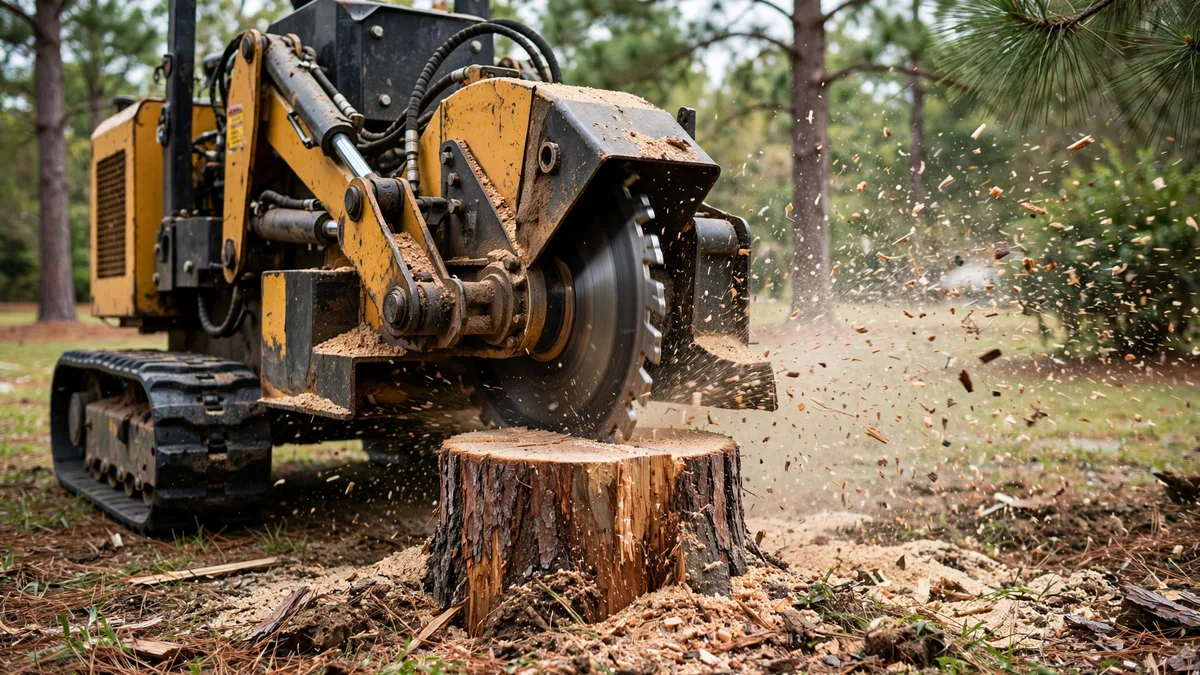
Stump grinding uses a powerful machine with a rotating cutting wheel to shred the stump into wood chips, working from the top down to about 6–12 inches below the soil surface. The operator grinds the stump and the upper portion of the major roots, then backfills the hole with the resulting chips mixed with soil.
What grinding does NOT do: remove the deeper root system. Those roots stay in the ground and decompose naturally over several years — which is perfectly fine for most yards. The ground above can be sodded, seeded, or landscaped almost immediately.
A typical residential stump takes 30–60 minutes to grind. Most Jackson homeowners choose this option because it's the least disruptive way to reclaim their yard.
What Is Full Stump Removal?
Full stump removal (sometimes called stump extraction) digs the entire stump out of the ground — stump, root ball, and major lateral roots — usually with an excavator or by hand-digging around large specimens. What's left is a crater that gets backfilled with soil.
This is the nuclear option. It's more expensive, takes longer, tears up a larger area of your yard, and requires heavy equipment access. But it completely eliminates the stump and most of its roots, which matters in specific situations:
- You're building a structure, patio, driveway, or pool in that exact spot
- You're replanting a new tree in the same hole (old roots can interfere with establishment)
- The species aggressively suckers from roots (crepe myrtle, Bradford pear, sweetgum, and some oaks will send up shoots for years from remaining roots)
- You're dealing with a disease issue and want the infected wood fully out
Stump Grinding vs. Stump Removal: Side-by-Side Comparison
| Factor | Stump grinding | Full stump removal |
|---|---|---|
| Typical cost (Jackson, MS) | Quoted per stump | Quoted per stump |
| Time on site | 30–60 minutes | Half day or more |
| Yard disruption | Small area, minimal | Large excavation, heavy equipment |
| Roots removed | Stump + upper roots only | Stump + root ball + major roots |
| Replant in same spot | Wait 6–12 months, or offset a few feet | Immediately |
| Regrowth risk | Possible with aggressive species | Very low |
| Best for | Most residential yards | Construction, replanting, aggressive suckers |
Which Do You Need? A Simple Decision Guide
Choose stump grinding if: - You want the stump gone and the yard usable again — the standard case - You're laying sod, planting grass, or landscaping over the area (just offset from the old stump center) - Budget matters — grinding is typically half to a third the cost of extraction - Your yard has limited equipment access for an excavator - The stump is from a species that doesn't sucker aggressively (most pines, for example)
Choose full stump removal if: - You're building something in that exact location — a patio, shed, driveway, or pool needs undisturbed, compactable soil - You're planting a new tree in the same hole — decaying old roots can harbor fungi and physically block the new root ball - The old tree was a heavy suckerer. Crepe myrtles, Bradford pears, sweetgums, and some oaks will send up root sprouts for years. Grinding reduces but doesn't eliminate this; extraction does - An arborist has identified a root-zone disease you want fully out of the soil
Still unsure? A stump grinding service visit can assess the species, location, and your plans — most of the time, the answer is grinding.
The Termite Angle: Why Stumps Shouldn't Sit in Mississippi
Here's something Jackson homeowners should know: a decaying stump is prime real estate for subterranean termites. Mississippi's warm, humid climate makes it one of the most termite-active states in the country, and dead wood in contact with soil is exactly what termite colonies feed on.
A stump sitting in your yard for years can host a colony that eventually explores toward your home's foundation. The Mississippi State University Extension Service notes that eastern subterranean termites are active year-round in the South and that colonies take years to grow large enough to be noticed — by which point significant damage may already be done. (Source: MSU Extension on subterranean termites)
Grinding the stump removes the food source and eliminates that particular risk. It's one more reason not to let stumps linger — especially stumps within 20–30 feet of your house.
What Happens After the Stump Is Gone?
After grinding: The hole gets backfilled with wood chips and soil. You can spread grass seed or lay sod over it within days. The chips settle over a few months — top off with soil if a depression forms. If you want to plant a new tree, offset it 3–5 feet from the old stump center so the new roots establish in undisturbed soil. Our tree planting guide covers species selection for Mississippi clay.
After full removal: The excavated area gets backfilled and compacted with clean fill dirt. You can build, pave, or plant immediately. Expect the backfilled area to settle somewhat over the first rainy season — plan a top-off.
Either way, confirm with your contractor exactly what's included: grinding depth, chip disposal vs. spreading, backfill material, and whether the quote covers surface restoration.
Get Your Stump Handled Right
Whether it's grinding or full removal, the right choice depends on your stump, your soil, and your plans for the yard. We'll assess it and give you an honest recommendation — not an upsell.
Call +1 (647) 367-1424 for a free stump estimate anywhere in the Jackson metro. Or explore our stump grinding service and tree removal pages for bundled pricing.
Call Now: +1 (647) 367-1424 WhatsApp Request Free Estimate(/contact/)
Sources
- Mississippi State University Extension Service — Eastern subterranean termites: signs, swarming, and professional treatment: http://extension.msstate.edu/news/feature-story/2025/treat-houses-buildings-swarming-termites-are-found
Frequently Asked Questions
How much does stump grinding cost in Jackson, MS?
Single stumps are priced mainly by stump diameter — call for a fast quote. Large stumps (30+ inches) or multiple stumps cost more per job but less per stump. Full stump extraction is priced because it requires an excavator and more labor.
Will the stump grow back after grinding?
The stump itself won't regrow, but some species send up root suckers from remaining roots — crepe myrtle, Bradford pear, and sweetgum are the usual offenders in Mississippi. If regrowth is a concern, discuss deeper grinding or full removal with your contractor.
How deep do you grind stumps?
Standard residential grinding goes 6–12 inches below grade — deep enough to lay sod, plant grass, or landscape over. Deeper grinding is available for replanting situations; specify the depth you need in your quote.
Can you grind a stump next to my house or fence?
Usually yes, with a compact grinder. Tight access is one of the main reasons grinding beats extraction — excavators need significant room to maneuver. Mention access constraints when you request your estimate.
Do I need to be home during stump grinding?
No. As long as the crew can access the stump and you've agreed on the scope (depth, chip disposal, restoration), the work can be done while you're away. Most companies send before-and-after photos.
Should I remove the stump myself?
Stump grinders are rentable, but they're genuinely dangerous machines — the cutting wheel spins at high speed and throws debris. Between rental cost, transport, and injury risk, professional grinding is usually the better value for a single stump.