Last updated: September 21, 2026
Most problem trees don't fail without warning. They advertise their decline for months or years — dead limbs, cracks, fungus, a lean that wasn't there last spring. Learning to read those signals is the difference between a planned removal and a costly emergency when the tree meets your roof in a storm. Here are the seven signs we look for on every assessment in the Jackson metro.
1. Large Dead Branches Throughout the Crown
A few dead twigs are normal. Large dead limbs scattered through the crown are not — they indicate the tree is shutting down sections it can no longer support. Deadwood is also the most immediate physical danger on this list: a dead limb doesn't bend in wind, it breaks, and it falls without warning.
Quick check: scratch a small twig with your thumbnail. Green, moist tissue underneath means alive; dry, brown, and brittle means dead. Test several branches around the crown — if most of the outer branches are dead, the tree is in serious decline.
Dead limbs over roofs, driveways, sidewalks, or play areas should come down promptly regardless of what you decide about the whole tree. If the tree is otherwise healthy, professional pruning can remove the hazard and buy the tree years.
2. Cracks, Cavities, and Trunk Decay
The trunk is the tree's structural column, and damage here matters more than anywhere else. Watch for:
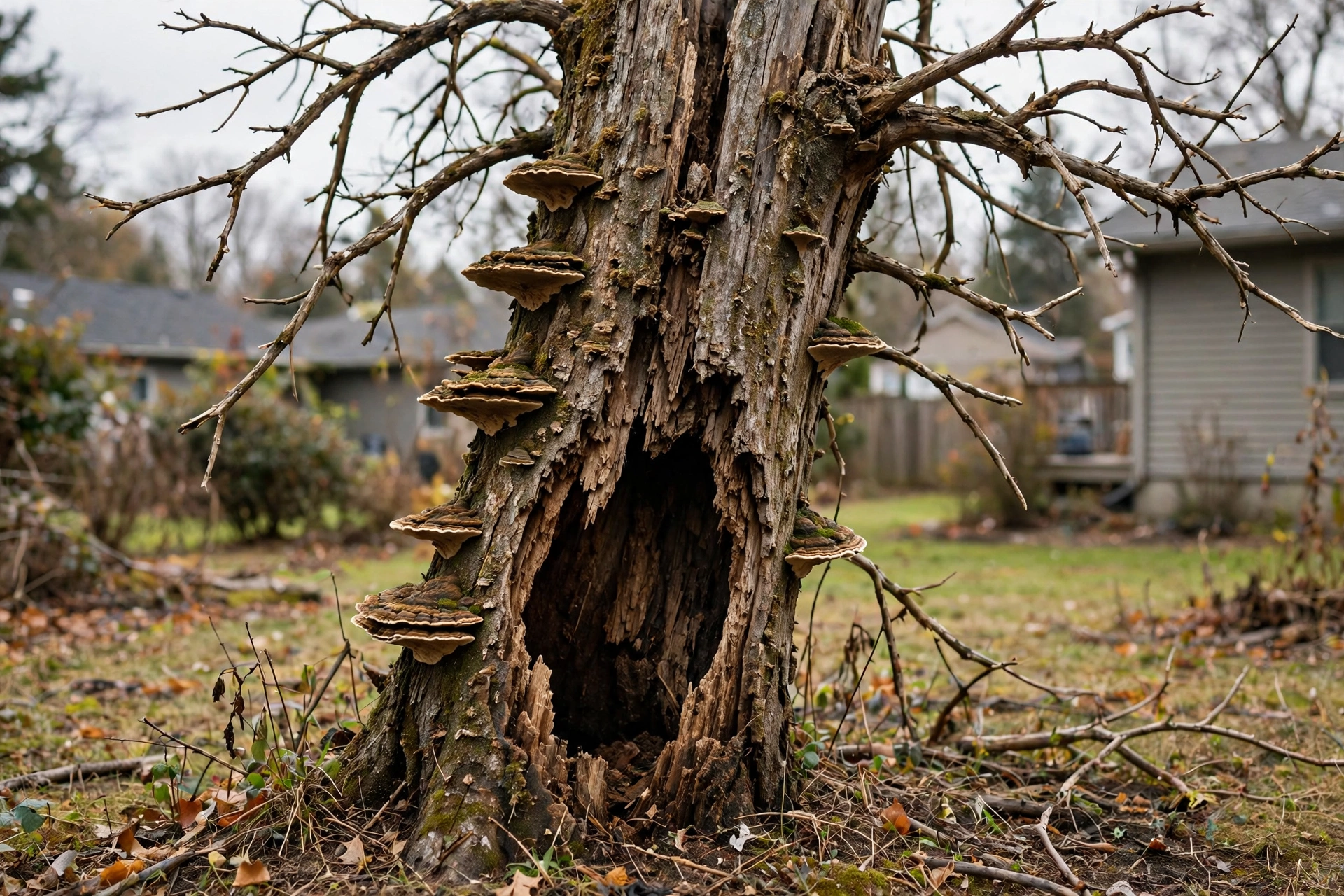
- Vertical cracks or splits, especially ones that go deep or run through branch unions
- Cavities — hollow areas where decay has eaten the interior wood
- Missing bark in large patches, exposing dead wood underneath
- Conks or shelf fungi growing directly from the trunk (different from base fungus — this means the trunk wood itself is decaying)
A widely used rule of thumb: if a cavity or decay affects more than about a third of the trunk's circumference, the tree's structural integrity is seriously compromised. Small, compartmentalized cavities in an otherwise vigorous tree can be monitored; large or growing decay columns usually point toward removal.
3. Mushrooms or Fungal Fruiting Bodies at the Base
Mushrooms growing from the root flare or around the base of the trunk are one of the most reliable indicators of internal root or butt rot. The mushroom is just the fruit — the actual fungus is a network digesting the tree's structural roots from the inside.
This is the sign homeowners most often dismiss ("it's just mushrooms from the rain") and the one we take most seriously on assessments. A tree can look full and green in the canopy while its root system is being hollowed out below ground. By the time canopy symptoms appear, the structural damage is usually advanced.
If you see fungal fruiting bodies at the base, get a professional assessment promptly — especially for trees near your home. This is not a wait-and-see situation.
4. A Sudden Lean — Especially After Rain
Trees don't develop new leans for no reason. A tree that starts leaning — or an existing lean that suddenly increases — is telling you its root anchorage is failing.
In Jackson, this sign carries extra weight. Much of the metro sits on Yazoo clay, expansive soil that swells when saturated and shrinks as it dries. After extended heavy rain, that saturated clay loses grip on root plates, and trees that stood straight for decades can start tipping. If you notice a new lean after a wet spell — or soil heaving and cracking on one side of the trunk — treat it as urgent. A leaning tree near a house, driveway, or power line may need emergency evaluation.
One nuance: some trees grow with a natural, stable lean from youth (reaching for light). A lean that's been there for years and hasn't changed is far less concerning than a new or increasing one. When in doubt, photograph it and compare over a few weeks — or just call us and we'll tell you which kind you're looking at.
5. Root Damage from Construction or Trenching
Roots are the tree's foundation and its mouth — damage them and the decline that follows can take 2–5 years to fully show. Common causes in the Jackson metro's growth corridors (Flowood, Brandon, Byram):
- Trenching for utilities, irrigation, or drainage through the root zone
- Grade changes — adding or removing soil over roots suffocates them
- Soil compaction from heavy equipment parked under the canopy
- Cutting roots to install driveways, patios, or foundations
The general guideline is that severing roots within the tree's critical root zone (roughly a radius of 1–1.5 feet per inch of trunk diameter) causes serious harm. A tree that was fine during construction and has been thinning for three years since is a classic root-damage case. Severely root-damaged trees rarely recover fully — and they become progressively more failure-prone as the damaged root system decays.
6. More Than 50% Canopy Dieback
When over half the canopy is dead or dying — bare branches where leaves should be, thinning crowns that get worse each year — the tree has crossed a threshold. It can no longer photosynthesize enough energy to maintain itself, let alone fight off pests and disease. Dieback at this scale is usually irreversible.
Before assuming the worst, rule out the temporary: some species leaf out late, and drought years cause thinning that recovers. But dieback that progresses year over year, or a crown that's mostly bare by midsummer, means the tree is in terminal decline. At that point, removal is a question of timing and safety, not whether.
7. Severe Pest Damage — Pine Beetle Kill
In central Mississippi, the fastest tree killer isn't disease or storms — it's the southern pine beetle. The Mississippi Forestry Commission calls it the most destructive forest insect pest in the South, and it doesn't stay in forests: landscape pines are fully susceptible (source).
What to look for: small pitch tubes on the bark (white, yellow, or reddish-brown, about the size of a wad of gum), boring dust, and crowns fading from green to yellow to reddish-brown. During outbreaks, a pine can go from healthy-looking to dead in weeks. MSU Extension notes that storm-stressed trees are especially vulnerable to bark beetle attack — relevant in Mississippi, where ice storms and hurricanes regularly stress pines (source).
A beetle-killed pine can't be saved — but quick removal of infested trees can protect the healthy pines around it, since beetles spread from tree to tree. If you have pines and spot pitch tubes, don't wait for the crown to fade. By then, the tree is already lost and the beetles may have moved on.
Signs Your Tree Can Be SAVED Instead
Honest assessments cut both ways. Plenty of concerning-looking trees don't need removal:
- Minor deadwood in an otherwise healthy crown → crown cleaning removes the hazard and the tree thrives.
- Structural weakness in a valuable mature tree → cabling and bracing can support split trunks and weak unions for years — the right call for heritage oaks in Madison and Ridgeland.
- Early-stage disease or pest pressure → plant health care — fertilization, systemic treatments, soil care — genuinely saves trees when problems are caught early.
- A long-stable lean → monitoring, not removal. We'll tell you which kind of lean you have.
- Surface root issues or minor construction impact → mulching, watering, and time can bring a stressed-but-viable tree back.
Our rule is simple: if a tree can be safely saved for reasonable cost, we'll say so — even though removal pays us more. That honesty is why our customers call us back and refer their neighbors.
What to Do If You Spot These Signs
- Don't ignore a new lean or base fungus. These two signs indicate potential structural failure. Everything else on this list allows more deliberation; these two deserve a prompt assessment.
- Keep people and property clear of the fall zone. Until a professional evaluates the tree, treat the area within striking distance as off-limits — especially for kids and pets.
- Take photos. Document what you're seeing, including close-ups of bark, fungus, cracks, and the lean from a fixed reference point. Photos help us triage over the phone and track changes over time.
- Don't DIY major dead-limb removal. Dead limbs under tension are among the most dangerous things a homeowner can cut. What looks like a simple pruning cut can release stored energy violently.
- Get a professional assessment. Most of these signs need eyes on the tree to interpret correctly — a cavity that looks terrifying might be compartmentalized and stable, while a healthy-looking pine might be beetle-killed inside.
Not Sure What You're Looking At? Get a Free Assessment
You don't need to diagnose your own tree. That's our job — and the assessment is free.
Call +1 (647) 367-1424. We'll inspect the tree, explain honestly whether it needs removal or can be saved, and give you a written quote. Serving Jackson, Brandon, Madison, Ridgeland, Clinton, Pearl, Flowood, Richland, Byram, and Florence.
Call Now: +1 (647) 367-1424 WhatsApp Request Free Estimate
Wondering what removal will cost? See our 2026 tree removal cost guide for Jackson, MS.
Sources
- Mississippi Forestry Commission — Southern Pine Beetle: signs, lifecycle, and management: https://www.mfc.ms.gov/forest-health/forest-pests/southern-pine-beetle/
- MSU Extension Service — Defend Trees from Beetles, Disease in Storm Aftermath (2026): https://extension.msstate.edu/news/feature-story/2026/defend-trees-beetles-disease-storm-aftermath
Frequently Asked Questions
How do I know if my tree is dead or just dormant?
Use the scratch test: scrape a small twig with your thumbnail. Green, moist tissue means alive; dry brown means dead. Check several branches around the crown. Also, wait for spring leaf-out before condemning a tree — some species leaf out late, and a tree that looks dead in February may be perfectly fine. If most branches fail the scratch test by late spring, the tree is dead.
Can a leaning tree be saved, or does it have to come down?
It depends on the lean's history. A long-stable lean the tree grew with is often fine to monitor. A new or increasing lean — especially after heavy rain on Yazoo clay — indicates root failure and usually means removal, urgently if the tree threatens a structure. A professional assessment distinguishes the two quickly.
Will my homeowner's insurance cover removing a dangerous tree?
Generally, insurance covers removal when a storm-damaged tree has fallen on a covered structure — not the preventative removal of a standing dead or leaning tree. Policies vary significantly, so check with your agent about your specific coverage. We document storm damage with photos to support claims when we do emergency work.
How quickly does a dangerous tree need to come down?
A tree actively failing — new lean after rain, large hanging limbs, trunk splitting — should be addressed within days, not months. Trees with progressive decline (dieback, cavities) can usually be scheduled normally. If you're unsure which category you're in, call {{PHONE}} and describe what you're seeing; we'll triage honestly.
Can a tree with pine beetles be saved?
It depends on the stage. Early, limited attacks on otherwise healthy pines can sometimes be managed — but once the crown is fading significantly, the tree is lost; beetles have already girdled it beneath the bark. At that point, prompt removal protects neighboring pines from the spreading infestation. If you spot pitch tubes, get an assessment immediately — speed is everything with this pest.