Last updated: September 21, 2026
What Kudzu Is — and Why Mississippi Is Ground Zero
Kudzu (Pueraria montana var. lobata) is a fast-growing perennial vine introduced to the Southeast in the late 1800s, famously promoted in the 1930s–40s for erosion control. That promotion worked too well. Kudzu now covers an estimated 7+ million acres across the South, and Mississippi — with its long growing season, abundant rainfall, and mild winters — is some of the most hospitable kudzu habitat on earth.
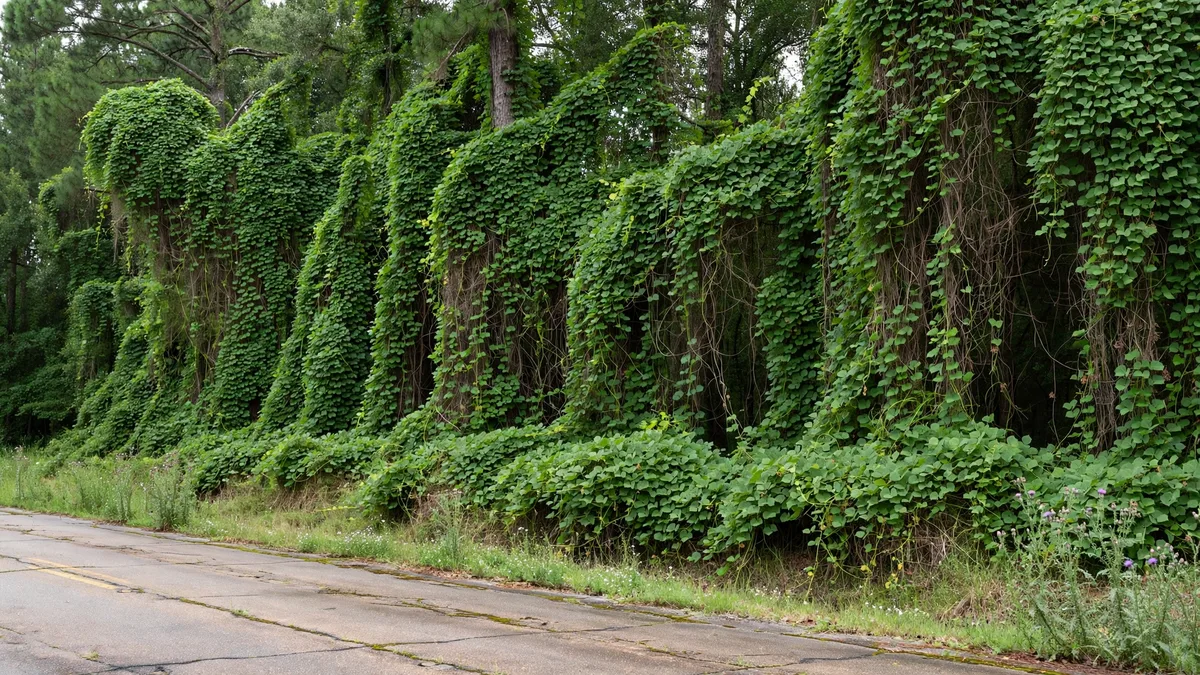
In the Jackson metro, you'll see it blanketing trees along I-20, I-55, and Highway 49, swallowing fence lines in Rankin County, and creeping from vacant lots into neighboring yards in Hinds and Madison counties. It grows up to a foot per day in peak summer. A patch you ignore in May can own your fence line by August.
Identification is straightforward: large trifoliate (three-lobed) leaves, hairy vines that climb anything vertical, and in late summer, clusters of fragrant purple flowers. If it's climbing your trees, it's kudzu until proven otherwise.
How Kudzu Kills Trees
Kudzu doesn't poison trees — it overwhelms them mechanically, and the process is brutally effective:
Smothering. Kudzu vines climb into the canopy and spread a dense blanket of leaves over the tree's own foliage. The tree can't photosynthesize through the blanket. Deprived of light season after season, the tree weakens, stops growing, and eventually dies standing.
Weight. A mature kudzu infestation adds enormous weight to branches — hundreds of pounds of vine, leaves, and trapped moisture. Limbs break. Whole trees, especially pines with shallow root plates in Mississippi's wet soils, get pulled over entirely.
Girdling and competition. Vines wrapping tightly around trunks can constrict growth, and kudzu's massive root system — with taproots running 6+ feet deep — outcompetes tree roots for water and nutrients.
The timeline. A healthy mature tree can survive a few seasons of light kudzu encroachment. But once the vine reaches the upper canopy and closes over it, the tree is on borrowed time — typically 2–5 years to death depending on species and infestation density. Young trees and pines go faster.
This is why early action matters. Kudzu on the ground near your trees is a weekend project. Kudzu in the canopy is a professional job.
Kudzu Control Methods That Work in Mississippi
Controlling kudzu is a multi-year commitment — there is no reliable one-and-done method for established patches. The Mississippi State University Extension Service's Publication 3187 is the authoritative reference for control specifics; what follows is a plain-English overview of the approaches it documents. (Source: MSU Extension — Kudzu, Publication 3187)
Cutting and mowing (mechanical control)
Repeated cutting starves the root system over time. Mow or cut kudzu patches to the ground every few weeks during the growing season, and cut climbing vines at the base of trees (cut the vine, leave the upper portion to die and fall naturally — don't yank vines out of canopies, which can damage branches or pull dead limbs down on you). Expect 2–3+ years of consistent cutting to exhaust established root crowns. Grazing livestock — goats famously love kudzu — can suppress patches on acreage.
Smothering and tarping
Covering small patches with heavy tarps or thick mulch layers blocks the light kudzu needs. This works for defined garden-bed-scale areas but is impractical for large infestations, and the edges need constant monitoring — kudzu will find the gap.
Herbicide treatment (chemical control)
For established patches, targeted herbicide application is usually the most effective approach — but this is where you should follow the experts, not internet recipes. MSU Extension Publication 3187 documents specific herbicides, formulations, methods, and application rates tested for Mississippi conditions, and it stresses reading and following all label directions. Herbicide choice and timing matter enormously: the wrong product at the wrong time wastes money and can damage desirable plants (some effective kudzu herbicides persist in soil and prevent replanting).
We do not publish specific herbicide products or rates in this guide — labels change, regulations change, and misapplication near trees, gardens, wells, or waterways causes real harm. Read Publication 3187 and follow its guidance, or hire professionals who do this work routinely.
The realistic program
For most Jackson-area homeowners, effective kudzu control looks like this: cut climbing vines off trees immediately (year 1, right now), then commit to a 2–3 year program of repeated cutting plus targeted treatment of regrowth per Extension guidance. Monitor the edges — kudzu spreads by runners (stolons) that root wherever they touch soil, so a patch "controlled" in the middle but spreading at the edges isn't controlled.
Kudzu Look-Alikes in Mississippi
Before you declare war, make sure you're fighting the right vine. Several Mississippi natives and ornamentals get mistaken for kudzu:
Poison ivy (Toxicodendron radicans) — also has three leaflets, but they're smaller, glossy or matte with irregular teeth, and the plant produces no purple flowers. Critical distinction: poison ivy causes severe rashes. If you're unsure, don't handle it — have someone experienced identify it first.
American wisteria (Wisteria frutescens) — a native vine with pinnate leaves (many leaflets along a stem, not three) and hanging purple flower clusters in spring. Beautiful and far less aggressive than kudzu; worth preserving.
Trumpet creeper (Campsis radicans) — pinnate leaves with orange-red trumpet flowers that hummingbirds love. Can be aggressive in its own right but manageable, and it's native.
English ivy — evergreen with lobed leaves that climb walls and trees, but it doesn't produce the massive summer growth surges kudzu does. Still invasive and worth controlling, just with different methods.
The telltale kudzu signature: very large trifoliate leaves (each leaflet up to 4 inches wide), densely hairy vines, extremely fast summer growth, and those fragrant purple flower clusters in August–September. When in doubt, your county Extension office will identify a sample for you.
When to Call a Professional
DIY kudzu control is reasonable for patches under a few hundred square feet. Call a professional when:
- Kudzu is already in the tree canopy. Cutting vines at the base is step one, but assessing whether the tree can be saved — and safely removing dead vine mass and compromised limbs — is professional work. Our brush clearing and kudzu removal service handles exactly this.
- The infestation covers a large area. Acreage-scale kudzu needs equipment (forestry mulchers, brush cutters) and a systematic treatment program, not a string trimmer and weekends.
- Steep slopes or difficult terrain are involved. Kudzu loves ditch banks and slopes — exactly where DIY work is most dangerous.
- Desirable trees are intermixed. Selectively freeing your oaks and magnolias while eliminating the vine takes judgment about what to cut and what to spare. That's what our tree health care assessments cover.
- You've been fighting it for years without progress. Established root crowns can be remarkably persistent. A professional program with the right equipment and follow-up schedule breaks the cycle.
Keeping Kudzu Off Your Neighbor's Property
Kudzu doesn't respect property lines — it spreads by runners that root wherever they touch soil, plus seeds that birds and water carry. In the Jackson metro, the most common kudzu conflicts start at the boundary between a maintained yard and an overgrown adjacent lot.
A few practical steps:
- Maintain a cut buffer. Keep a 6–10 foot mowed or cleared strip along your property line. Kudzu runners crossing open, mowed ground are easy to spot and cut before they establish.
- Watch the fence line. Chain-link and wooden fences are kudzu highways. Check them monthly from May through September and cut any vines climbing through.
- Talk to your neighbor early. If the source patch is on an adjacent property, a friendly conversation in spring — before growing season — works better than a complaint in August when their kudzu is eating your shed. Many neighbors simply don't realize what they have.
- Document for rental or HOA situations. If you rent, kudzu control is typically the property owner's responsibility — notify them in writing. Some Jackson-area HOAs have nuisance vegetation rules that cover invasive vines spreading between lots.
You can't control what grows on someone else's land, but a maintained buffer on your side stops most encroachment before it becomes your problem.
Mississippi Cost-Share Programs for Kudzu Treatment
Here's something many Mississippi landowners don't know: the Mississippi Forestry Commission runs kudzu treatment cost-share programs that can reimburse part of the cost of professional kudzu treatment for eligible private landowners. Programs include options for forested situations (typically 10+ contiguous forested acres, often through the Forest Resource Development Program) and non-forested situations.
Funding is limited and applications go on a waiting list, so this isn't instant help — but if you own acreage with a kudzu problem, it's worth investigating. Start at the MFC's kudzu page for current program details and eligibility: Mississippi Forestry Commission — Kudzu.
For smaller residential properties that don't qualify, professional clearing is still usually the most cost-effective path — compare one professional job against three summers of your weekends.
Reclaim Your Property From Kudzu
Kudzu doesn't negotiate and it doesn't wait. If it's climbing your trees or swallowing your lot, every growing season makes the job bigger.
Call +1 (647) 367-1424 for a free kudzu and brush assessment anywhere in the Jackson metro. We'll tell you honestly whether it's a DIY-scale patch or a professional job — and if it's the latter, our brush clearing and kudzu removal service will give you a clear, written plan.
Call Now: +1 (647) 367-1424 WhatsApp Request Free Estimate(/contact/)
Sources
- Mississippi State University Extension Service — Kudzu (Publication 3187), identification and control methods: http://extension.msstate.edu/publications/kudzu
- Mississippi Forestry Commission — Kudzu treatment assistance and cost-share programs: https://www.mfc.ms.gov/forest-health/invasive-plants/kudzu/
Frequently Asked Questions
How fast does kudzu grow in Mississippi?
In peak summer conditions, kudzu can grow up to a foot per day. A small patch at the edge of your property in May can cover a fence line, shed, or young tree by late summer. Mississippi's long growing season and rainfall make it ideal kudzu country.
Will kudzu actually kill my trees?
Yes. Kudzu smothers canopies (blocking photosynthesis), adds tremendous weight that breaks limbs and topples trees, and outcompetes roots for water and nutrients. Once it closes over a tree's canopy, that tree typically dies within 2–5 years.
Can I just pull kudzu off my trees?
Cut climbing vines at the base and let the upper portions die and fall naturally — don't yank vines out of the canopy, which can break branches or pull dead limbs down on you. Then deal with the regrowth at ground level per a sustained control program.
What's the best herbicide for kudzu?
We deliberately don't recommend specific products or rates here — labels and regulations change, and misapplication damages desirable plants and the environment. The Mississippi State University Extension Service's Publication 3187 documents tested herbicides, rates, and timing for Mississippi: MSU Extension — Kudzu. Follow it exactly.
How long does it take to get rid of kudzu?
For established patches, plan on 2–3+ years of consistent effort — repeated cutting, targeted treatment, and edge monitoring. Anyone promising one-visit permanent eradication is selling something. Honest professionals will tell you kudzu control is a program, not an event.
Does the state help pay for kudzu removal?
Possibly, for qualifying landowners. The Mississippi Forestry Commission operates kudzu treatment cost-share programs with eligibility requirements (often acreage-based) and limited funding. Check current details at mfc.ms.gov.