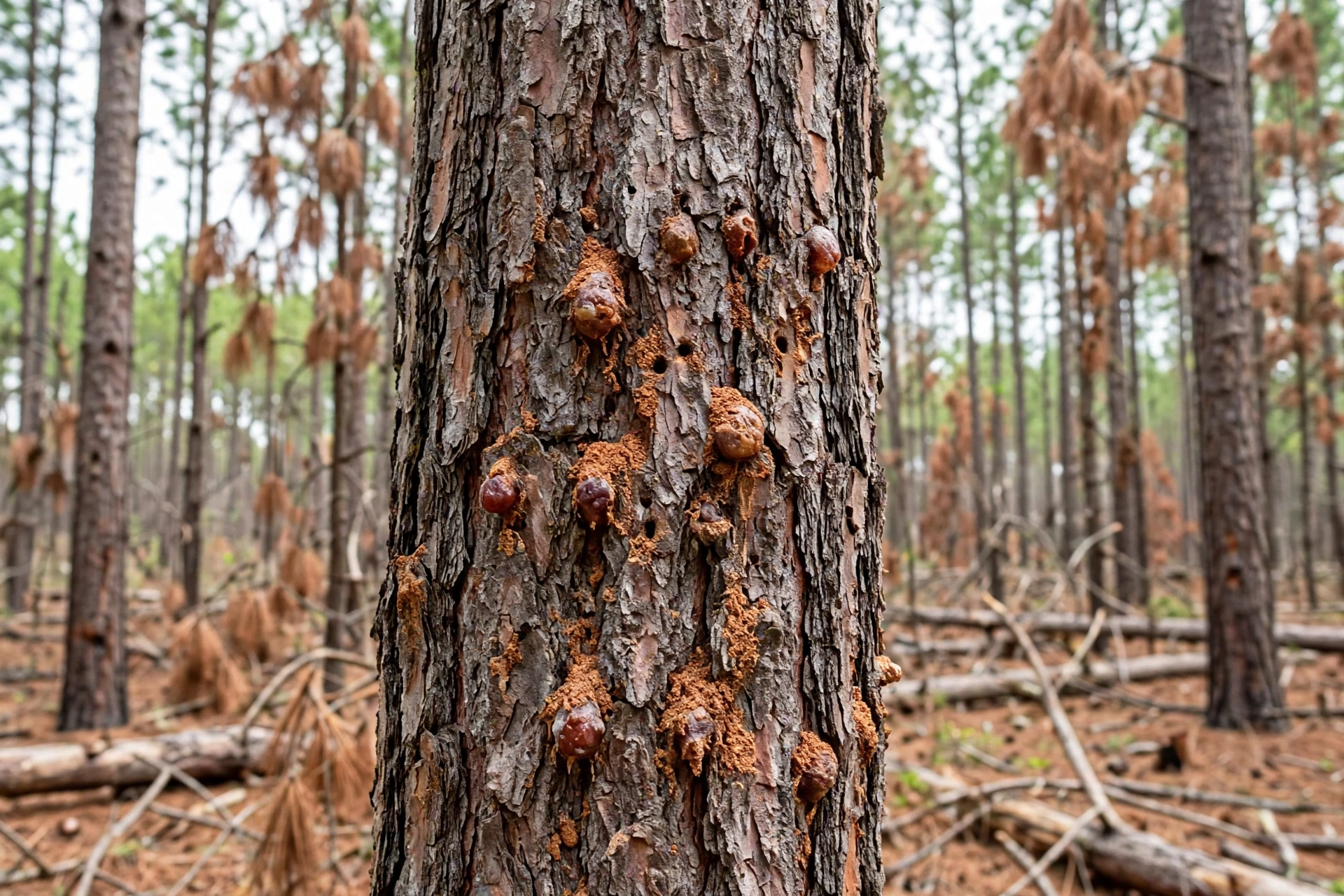
Southern Pine Beetle: Mississippi's #1 Tree Killer
The southern pine beetle (Dendroctonus frontalis) has destroyed more Mississippi pine timber than any other pest in the state's history, according to the Mississippi Forestry Commission. And it doesn't stay in forests — suburban pines in Brandon, Byram, Florence, and across the Jackson metro are all vulnerable, especially loblolly and shortleaf pines stressed by drought, construction damage, or lightning strikes.
How to Spot an Infestation
Catch these signs early — speed is everything with pine beetle:
- Pitch tubes: small, popcorn-like masses of resin on the bark, roughly the size of a pencil eraser. These form where beetles bored into the tree and the pine tried to "pitch out" the invaders. Fresh pitch tubes are soft and white; old ones harden and darken.
- Fading crowns: needles turn from green to yellow-green, then yellow, then reddish-brown. By the time the crown is fully red, the tree is typically beyond saving — and beetles have likely moved on to neighboring pines.
- Boring dust: fine, reddish-brown sawdust in bark crevices and around the base of the tree.
- S-shaped galleries: peel back loose bark and you'll find winding, S-shaped tunnels etched into the wood — the beetles' signature.
- Woodpecker activity: heavy woodpecker feeding on a pine trunk often means beetles underneath the bark.
One infested tree can seed an outbreak across your whole property. Beetles emerge and attack neighboring pines in expanding waves called "spots" — which is why a single dying pine in a stand of healthy ones is an emergency, not a curiosity.
Why Speed Matters
Under outbreak conditions, southern pine beetles can kill a healthy pine in a matter of weeks. The beetles girdle the tree's inner bark, cutting off nutrient flow, while the blue-stain fungus they carry clogs the water-conducting tissue. It's a two-pronged attack, and once the crown has substantially faded, no treatment brings the tree back.
The Mississippi Forestry Commission and MSU Extension both emphasize the same point: early detection and rapid removal of infested trees is the primary defense for protecting the surrounding stand. Every week of delay is another generation of beetles emerging to attack your remaining pines.
Treatment vs. Removal: An Honest Assessment
Preventive treatments exist — but they prevent, they don't cure. Here's the honest breakdown:
- Preventive spraying: high-value, currently healthy pines can be treated with preventive insecticide applications during beetle-active periods. This is a protection strategy for specimen trees, not a rescue for infested ones.
- Once infested: if pitch tubes are fresh and the crown is still mostly green, rapid professional assessment is warranted — but be prepared for bad news. Once crown fade is extensive, removal is the responsible call.
- Remove promptly to protect the stand: infested trees left standing become beetle factories. Prompt removal — and proper handling of the wood — breaks the cycle and protects neighboring pines.
- Firewood warning: do not cut an infested pine into firewood and stack it near healthy pines. Beetles can emerge from cut wood and attack standing trees.
Suspect pine beetle on your property? Don't wait and watch. Call +1 (647) 367-1424 — our tree health specialists will assess the situation and give you straight answers about whether treatment or removal is the right move.
Oak Wilt: The Disease That Punishes Spring Pruning
Oak wilt is a fungal disease (Bretziella fagacearum) that kills oaks across the southeastern United States, and central Mississippi's live oaks and red oaks are squarely in its path. It's less visually dramatic than a pine beetle outbreak — no pitch tubes, no sudden red crowns — which makes it more insidious. By the time most homeowners notice oak wilt, it has a head start.
How Oak Wilt Spreads
Oak wilt travels two ways, and both matter for Jackson-area homeowners:
- Through fresh pruning wounds. Sap-feeding beetles carry oak wilt spores from infected trees to fresh wounds on healthy oaks. A pruning cut made in spring — when both the beetles and the fungus are active — is an open invitation. This is the transmission route you can control, and it's why pruning timing is the single most important oak wilt prevention measure.
- Through connected root systems. Oaks growing near each other often graft their roots together underground. The fungus travels through these grafts from a sick tree to healthy neighbors — which means one infected oak can take out a whole cluster without a single beetle involved.
Red oaks (including water oak and willow oak, common in the Jackson metro) typically die fast — sometimes within a single growing season. White oaks, including live oaks, tend to decline more slowly and can sometimes be managed — but "slower" still means a serious, progressive disease.
The Spring-Pruning Rule
This is the rule that saves oaks: prune oaks during the dormant season (late fall through winter), and avoid pruning in spring and early summer when oak wilt transmission risk is highest.
- Safest window: November through February in central Mississippi, when trees are dormant and the beetles that spread the disease are inactive.
- Highest risk: March through June — fresh wounds plus active beetles plus active fungus.
- If you must prune outside dormancy (storm damage can't wait for winter): prune only what's necessary, and paint or seal the wound immediately with wound dressing or latex paint. Sealing denies beetles access to the fresh wood. This is standard guidance from MSU Extension and university forestry programs.
- Always use clean practices: a crew that understands oak wilt disinfects tools between trees and never leaves fresh oak wounds exposed in spring.
This is also why you should never hire a crew that wants to "just trim up" your oaks in April. If they don't know the spring-pruning rule, they don't know Mississippi oaks.
Treatment Options — and Their Limits
Let's be direct: there is no cure for oak wilt once a tree is systemically infected. Anyone who tells you otherwise is selling something. What does exist is prevention and management:
- Prevention is the treatment. Proper pruning timing, immediate wound sealing, and avoiding unnecessary oak wounds are more effective than anything applied after infection.
- Fungicide injections may help protect high-value, currently healthy oaks near an infection — particularly white oaks and live oaks. This is a management tool for specimen trees, applied by qualified professionals, not a guaranteed save. Discuss realistic expectations before spending the money.
- Root-graft disruption: trenching between an infected oak and healthy neighbors can break the underground connections the fungus travels through. It's disruptive and situational, but it's the standard containment practice.
- Removal of infected red oaks: when a red oak is confirmed infected, prompt removal — before the next spring — prevents it from becoming a spore source for the whole neighborhood. Handle the wood responsibly; don't move infected oak firewood to new areas.
Worried about an oak on your property? Call +1 (647) 367-1424 for a professional assessment. We'll tell you honestly whether you're looking at oak wilt, something treatable, or nothing at all.
Other Mississippi Tree Threats Worth Knowing
Pine beetle and oak wilt are the headliners, but they're not the whole cast:
- Hypoxylon canker — a stress-driven fungal disease that attacks oaks and other hardwoods weakened by drought, construction damage, or age. Signs include bark sloughing off to reveal black, crusty fungal mats underneath. There is no effective treatment for advanced hypoxylon — management means reducing tree stress early and removing trees that are structurally compromised.
- Crape myrtle bark scale — an invasive insect leaving white, waxy scale on bark and black sooty mold on leaves. Unsightly and weakening, but treatable: systemic insecticide treatments and dormant oil applications are effective when applied correctly. If your crape myrtles look "dirty" with black coating, this is likely the culprit.
- Drought and clay-soil stress — not a pest, but the underlying weakness behind many infections. Yazoo clay's shrink-swell cycle stresses root systems, and stressed trees are dramatically more susceptible to every pest and disease on this page. Proper watering during drought and correct mulching are genuine disease prevention.
A Simple Prevention Program for Your Property
You don't need a forestry degree — you need a routine. Five habits that keep Jackson-area trees ahead of pests and disease:
- Walk your property twice a year. Spring and fall: look at bark, crowns, and root zones. You're watching for pitch tubes, unusual leaf color, fungal growth, bark loss, and new leaning. Ten minutes, twice a year, catches most problems early.
- Prune at the right time. Dormant-season pruning for oaks (November–February); late winter for most other species. Never let anyone top your trees or prune oaks in spring without wound sealing.
- Water during drought. Deep, infrequent watering during Mississippi dry spells keeps trees vigorous. Stressed trees invite beetles and canker.
- Mulch correctly. A 2–3 inch ring of mulch, kept away from the trunk — never piled against the bark ("mulch volcanoes" cause rot and invite pests).
- Act fast on symptoms. Pitch tubes, sudden crown fade, fungal mats, rapid defoliation — these are "call this week" symptoms, not "watch and see" symptoms. With pine beetle especially, days matter.
Want a professional baseline? Our tree health assessments cover pests, disease, soil, and structure — with a written plan, not a sales pitch. Call +1 (647) 367-1424.**
Protect Your Trees Before Pests Find Them
Pine beetle moves in weeks. Oak wilt punishes one bad pruning decision. The homeowners who come out ahead are the ones who know what to look for — and who call early.
Call +1 (647) 367-1424 for a professional tree health assessment anywhere in the Jackson metro — Jackson, Brandon, Madison, Ridgeland, Clinton, Pearl, Flowood, Richland, Byram, and Florence. Free estimates, honest answers, no pressure.
Call Now: +1 (647) 367-1424 WhatsApp Request Free Estimate
Jackson Tree Pros — Professional tree care for the Greater Jackson, Mississippi area. Disease information aligned with guidance from the Mississippi Forestry Commission (mfc.ms.gov), MSU Extension Service (extension.msstate.edu), and the US Forest Service.
Frequently Asked Questions
Can a pine tree with southern pine beetle be saved?
It depends on how far the infestation has progressed. If pitch tubes are fresh and the crown is still mostly green, call a professional immediately — there may be options. Once the crown has substantially faded to yellow or red, the tree is beyond saving, and prompt removal is necessary to protect neighboring pines.
How fast does the southern pine beetle kill a tree?
Under outbreak conditions, weeks — not months. The beetles girdle the inner bark while the fungus they carry clogs water-conducting tissue, a combination that overwhelms the tree rapidly. This speed is exactly why early detection and immediate response matter so much.
Can oak wilt be cured?
No — there is no cure for oak wilt once a tree is systemically infected. Management focuses on prevention (correct pruning timing, wound sealing), protecting nearby healthy oaks (fungicide injections for high-value trees, root-graft disruption), and promptly removing infected trees before they spread spores.
When is it safe to prune oak trees in Mississippi?
During dormancy — roughly November through February in central Mississippi. Avoid pruning oaks in spring and early summer (March–June), when the beetles that spread oak wilt are active and fresh wounds are most vulnerable. If storm damage forces pruning outside dormancy, seal wounds immediately.
Should I paint pruning wounds on my oak trees?
When pruning oaks outside the dormant season, yes — sealing fresh wounds with wound dressing or latex paint immediately after cutting is standard guidance from MSU Extension and university forestry programs. It denies disease-carrying beetles access to the fresh wood. During dormant-season pruning, sealing is less critical.
Do I need to remove a beetle-killed pine, or can it stay standing?
Remove it. A dead pine is a falling hazard, and an infested pine left standing produces generation after generation of beetles that attack your remaining healthy pines. Don't stack infested firewood near living pines either — beetles emerge from cut wood.