Call +1 (647) 367-1424 WhatsApp Get a Free Estimate
Free On-Site Estimates • Full Cleanup Included
When Does a Tree Need to Be Removed?
Not every problem tree needs to come down — but some do, and waiting too long turns a planned removal into an emergency. Here's how to tell, with Jackson-specific context:
The tree is dead or dying. No leaves in growing season, brittle bark falling off in sheets, branches snapping off in mild wind. Dead trees are unpredictable — they don't bend, they break, and they break without warning. A dead pine near your driveway in Brandon or a dead oak over a patio in Madison is a countdown, not a question.
Storm damage compromised its structure. Hurricane season runs June through November, and spring tornadoes do their share too. A tree that lost a major limb or split at a union may look fine for a month, then fail in the next storm. We assess storm-damaged trees honestly — some can be pruned back to health, others are structurally finished.
It's leaning — and it wasn't leaning before. Much of the Jackson metro sits on Yazoo clay, expansive soil that swells when wet and shrinks when dry. After extended heavy rain, that soil movement works roots loose. A newly leaning tree, soil heaving around the root flare, or cracks opening in the ground on one side of the trunk means the root system is failing. Don't wait on this one.
Disease has gone too far. Southern pine beetle can kill a pine in weeks — by the time the crown fades, the tree is often beyond saving and becomes a beetle source threatening neighboring pines. Oak wilt and advanced root rot similarly reach a point where removal is the only safe option. Our tree health specialists will tell you straight whether treatment is still viable.
It's threatening your home, foundation, or septic system. Roots crack foundations and invade drain fields; limbs rub roofs raw and give squirrels a highway into your attic. If a tree is damaging your house in Ridgeland or pressing on a septic field in Florence, removal is usually cheaper than the repair bill.
It's growing into power lines. Limbs in contact with lines are a fire and outage hazard. Call your utility company first — we handle everything outside their clearance zone and coordinate with them when a job spans both.
Not sure which category your tree falls into? That's exactly what our free assessment is for — and if your tree can be saved with pruning or cabling instead, we'll tell you. Read more about the warning signs.
Dead, leaning, or storm-damaged? Don't wait for the next storm. Call +1 (647) 367-1424 for a free on-site assessment.
Our Tree Removal Process
- On-site assessment. We walk your property, inspect the tree's health and structure, and check access, hazards, and what's underneath — fences, roofs, power lines, septic systems. You get an honest recommendation: remove, treat, or prune.
- Upfront written quote. One price, in writing, before any work begins. It covers the removal, cleanup, and any add-ons you choose, like stump grinding. No hidden fees.
- Scheduling. Most residential removals are scheduled within days, not weeks. Emergency situations jump the line — that's what our emergency service is for.
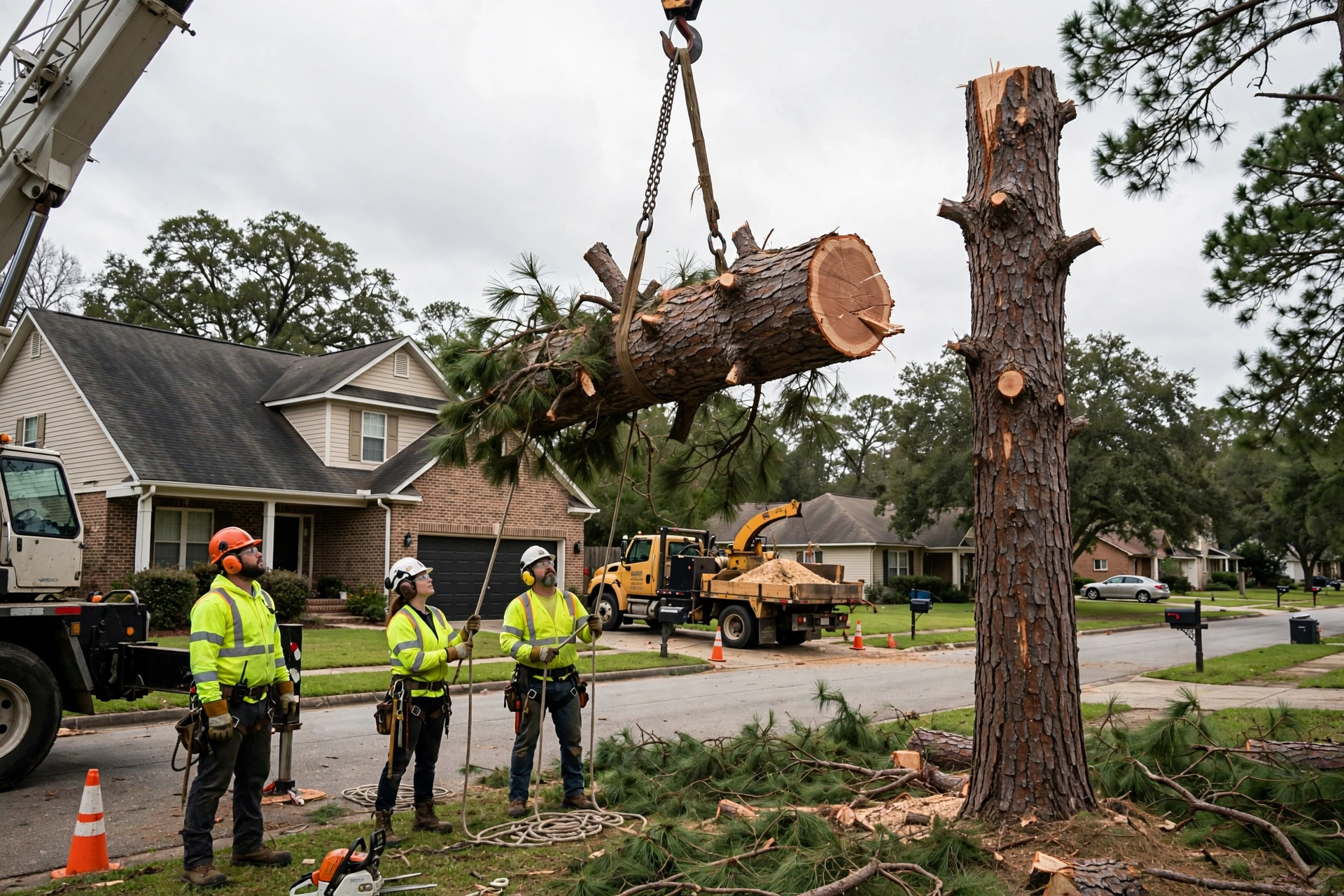
- Sectional dismantling or straight felling. On open lots with clear drop zones, we fell the tree in one controlled piece. In tight Jackson neighborhoods — houses close together, fences everywhere, pools in backyards — we climb and dismantle the tree section by section, lowering each piece with ropes and rigging. Cranes come out for the big, hazardous ones: dead trees too brittle to climb, or massive oaks with no safe drop zone.
- Stump options. We can leave the stump cut low, grind it 6–12 inches below grade so you can replant or lay sod, or remove it entirely. Bundling stump grinding with the removal is the cheapest way to do it.
- Full cleanup and walkthrough. Branches chipped on-site, logs hauled away or stacked for firewood — your call. We rake the work area clean and walk it with you before we leave.
How Much Does Tree Removal Cost in Jackson, MS?
| Tree size | Typical range in Jackson, MS |
|---|---|
| Small tree (under 30 ft) | Quoted per job |
| Medium tree (30–60 ft) | Quoted per job |
| Large tree (60+ ft — mature oak or pine) | Quoted per job |
| Emergency / storm-damage removal | Quoted per job |
| Stump grinding add-on | Quoted per stump |
What moves your price up or down:
- Species. Dense hardwoods like live oak cost more than pines of the same height — heavier wood, more rigging, slower work.
- Location and access. A tree in an open backyard is straightforward. The same tree wedged between your house, a fence, and a pool requires sectional dismantling and costs more.
- Proximity to structures and power lines. Anything requiring rope-and-rigging work near your roof takes longer and costs more than a clean fell.
- Tree condition. Counterintuitive but true: dead trees often cost more to remove than live ones. Dead wood is brittle and unpredictable — it can't be climbed safely, which means crane work.
- Cleanup level and stump work. Full haul-away and stump grinding add to the ticket but leave you with a finished yard.
The only honest way to price your tree is to look at it. Our estimates are free, on-site, and delivered promptly.
For the full breakdown by species and situation, see our 2026 tree removal cost guide for Jackson, MS.
Trees We Commonly Remove in Central Mississippi
Loblolly pine. Mississippi's most common tree — and one of its most failure-prone near homes. Tall, fast-growing, and brittle in high wind. After southern pine beetle moves through a stand, dead pines become an urgent removal backlog. If you've got a 70-foot pine leaning toward your roof in Pearl or Byram, that's a priority job.
Water oak. Short-lived, weak-wooded, and everywhere in older Jackson neighborhoods. Water oaks rot from the inside out — they can look full and green while the trunk is hollow. We see more surprise water oak failures than any other species in the metro.
Sweetgum. Fast growers with aggressive surface roots that lift driveways and sidewalks, plus the infamous spiky gumballs. Common removal request in Clinton and older Rankin County neighborhoods where they were planted as quick shade decades ago.
Bradford pear. The ornamental that turned invasive. Bradford pears split apart in storms with remarkable consistency — weak branch unions are a design flaw, not bad luck. If yours is still standing, consider replacing it before the next storm does the deciding. Our tree planting service can suggest tougher replacements.
Dead ash and beetle-killed pines. Once the canopy is gone and the bark is slipping, there's no treatment — only safe, prompt removal before limbs start dropping on their own.
Why DIY Tree Removal Is Dangerous
Every year in the U.S., chainsaws send tens of thousands of people to emergency rooms — and a large share of those injuries happen to homeowners, not professionals. Tree work combines every hazard at once: gravity, heavy wood under tension, chainsaws, ladders, and often power lines nearby.
The specific dangers of DIY removal:
- Felling miscalculation. A tree doesn't always fall where you aim it. Wind, lean, rot, and crown weight shift the outcome — professionals read all of these before the first cut.
- Limbs under tension. Storm-damaged limbs are loaded like springs. Cut in the wrong place and they snap back with enough force to kill.
- Power lines. Contact with a line doesn't require touching it — electricity can arc. This is utility-company territory, full stop.
- Insurance gaps. Damage caused by unlicensed DIY tree work may not be covered by your homeowner's policy the way damage from a hired, insured professional would be. Check your policy — and consider what a dropped limb through your neighbor's roof costs out of pocket.
Our crews do this every day with the right equipment: climbing gear, rigging, bucket trucks, and cranes for the jobs that need them. We're professional, and we show proof before work begins.
If a tree is worrying you, the safe move is a free professional assessment — not a chainsaw rental. Call +1 (647) 367-1424.
Tree Removal Across the Jackson Metro
We remove trees throughout Hinds, Rankin, and Madison counties:
- Tree service in Brandon, MS — Rankin County's growing hub, from new subdivisions to mature pine lots.
- Tree service in Madison, MS — Heritage oaks, HOA-governed neighborhoods, and high-value landscapes.
- Tree service in Ridgeland, MS — Natchez Trace corridor canopy and reservoir-area properties.
- Tree service in Clinton, MS — Established neighborhoods with large mature trees.
We also serve Pearl, Flowood, Richland, Byram, and Florence. As a full-service tree service in Jackson, MS, removal is just one part of what we do — most customers bundle it with trimming or stump grinding.
Get Your Free Tree Removal Estimate
Dead tree, storm damage, or a tree that's simply in the wrong place — get an honest professional assessment before the next storm makes the decision for you.
Call +1 (647) 367-1424 for a free on-site estimate anywhere in the Jackson metro. Free on-site estimates with no obligation. No obligation, no pressure — just a straight answer about your tree.
Call Now: +1 (647) 367-1424 WhatsApp Request Free Estimate
Jackson Tree Pros — Safe, professional tree removal for the Greater Jackson, Mississippi area.
Frequently Asked Questions
How much does tree removal cost in Jackson, MS?
Most residential removals in the Jackson area vary by tree size, species, and access — call for a free on-site estimate. Small trees cost the least; large oaks or pines near structures cost the most because they require sectional dismantling. Dead trees often cost more than live ones since brittle wood can't be climbed safely. We provide free on-site estimates with exact pricing.
Do I need a permit to remove a tree in Jackson, MS?
In most cases, no permit is required for trees on private residential property. Possible exceptions include heritage or landmark trees, trees in public rights-of-way, commercial properties, and HOA-governed communities — which are common in Madison and Ridgeland. Read our full guide to Jackson tree removal rules.
How long does tree removal take?
Most single residential trees are removed in half a day to a full day, including cleanup. Large or complex removals — crane work, tight access, multiple trees — can take two days. We'll give you a realistic timeline with your quote.
Will you grind the stump too?
Yes — stump grinding is available as an add-on to any removal, and bundling it with the removal visit is the most affordable way to do it. We grind 6–12 inches below grade, backfill, and leave the area ready for sod or replanting. Learn more about stump grinding.
What happens to the wood and debris?
Your choice. We chip branches on-site and can haul all wood away, or cut it into firewood lengths and stack it for you. Full cleanup of the work area is included either way — we rake everything clean before we leave.
Do you work in winter?
Yes, year-round. Winter is actually an excellent time for removals: trees are dormant, the ground is firmer, and scheduling is often faster. Pricing can be more favorable in the off-season, so winter removals are worth considering for non-urgent trees.