Last updated: September 21, 2026
What Is Tree Topping?
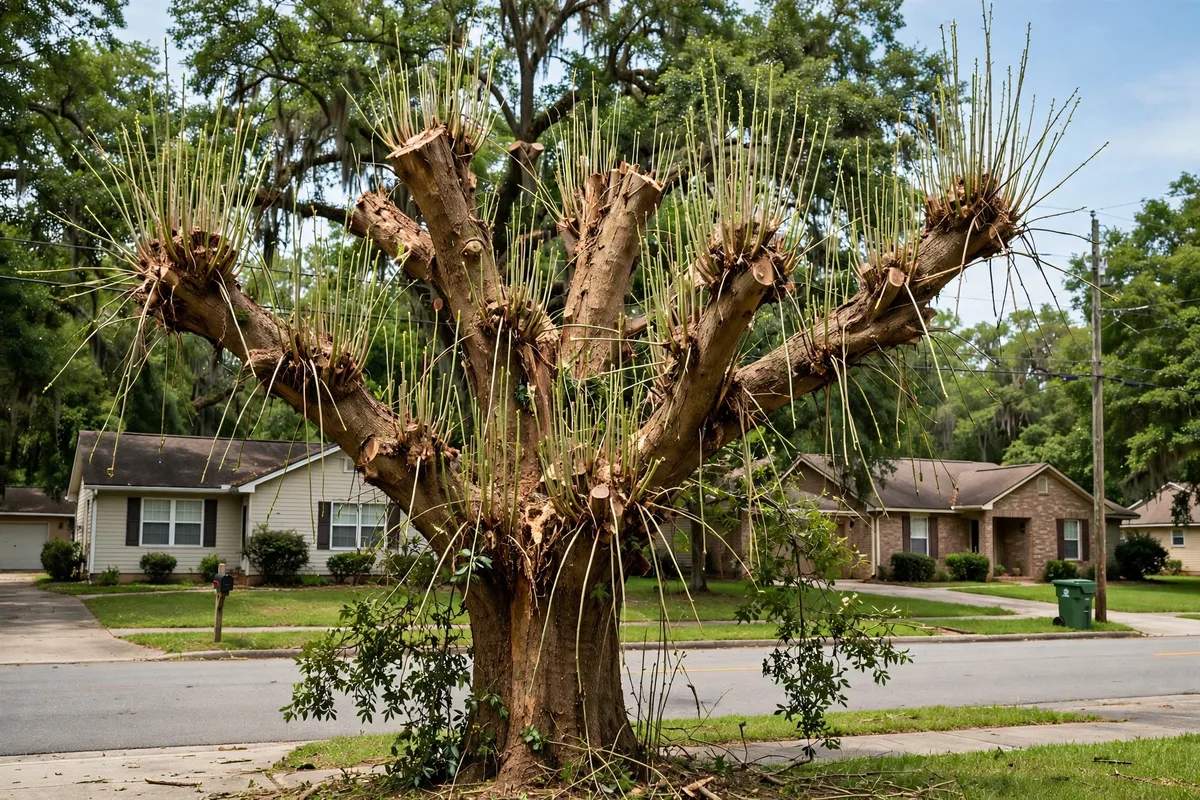
Tree topping is the indiscriminate cutting of a tree's crown — lopping off the top of the main trunk and major limbs, usually to a uniform height, leaving ugly stubs. You see it on crape myrtles every February in Mississippi (gardeners call it "crape murder"), on oaks that someone decided were "too tall," and on pines under power lines hacked by unqualified crews.
Topping is sometimes sold as "trimming" by cut-rate operators. It is not trimming. Proper pruning removes specific branches back to their point of origin or to a suitable lateral branch. Topping just cuts everything at an arbitrary height, regardless of branch structure.
If a contractor proposes "topping" your tree — or uses words like "heading back," "dehorning," or "hat-racking" — that's your signal to get a second opinion.
5 Reasons Topping Harms Trees
1. It starves the tree
Leaves are a tree's food factories. Topping removes 50–100% of the leaf-bearing crown in one brutal session, instantly cutting off the tree's ability to photosynthesize. The tree must burn through stored energy reserves to survive — reserves it needed for root growth, disease defense, and wound healing. A topped tree is a starving tree.
2. It triggers weak, dangerous regrowth
Desperate to replace its lost canopy, a topped tree sends up dozens of fast-growing shoots (called watersprouts or epicormic sprouts) from the cut stubs. These shoots grow several feet per year — which looks like "recovery" to an untrained eye — but they're weakly attached to the outer layers of wood, not anchored deep in the trunk. In Mississippi storm country, those weakly attached shoots are the first things to snap off in high winds. Topping converts a structurally sound tree into a collection of future projectiles.
3. It opens the door to decay
Proper pruning cuts are small and placed where the tree can seal them. Topping creates large wounds — sometimes 6+ inches across — that the tree cannot compartmentalize effectively. Fungi and bacteria enter through these wounds and rot spreads down into the trunk. Within a few years, topped limbs are often hollow shells of decay holding up heavy regrowth. The Mississippi State University Extension Service's pruning guidance emphasizes proper cut placement precisely because bad cuts invite decay. (Source: MSU Extension — Pruning Landscape Plants)
4. It causes sunscald and stress
The inner bark and remaining limbs of a topped tree are suddenly exposed to full Mississippi summer sun after years in the canopy's shade. The result is sunscald — bark damage that creates yet another entry point for pests and disease. Combined with the starvation stress, topped trees become magnets for borers, canker diseases, and secondary problems.
5. It's ugly and expensive long-term
A topped tree never regains its natural form. Instead you get a stubby trunk sprouting a broom-like tuft of weak shoots — the classic "coat rack" silhouette. And the economics are terrible: topping seems cheap upfront, but you'll pay for repeated corrective pruning of the watersprouts, potential hazard mitigation as decay sets in, and often premature tree removal years earlier than the tree's natural lifespan. Proper pruning costs more per visit but far less over the tree's life.
What to Do Instead of Topping
Whatever problem topping was supposed to solve, there's a proper arboricultural answer:
- Tree too tall? → Crown reduction. A trained pruner reduces the canopy's height and spread by cutting selected branches back to suitable lateral limbs — typically removing no more than 20–25% of the canopy. The tree keeps its natural form and structural integrity.
- Limbs over the roof? → Crown raising or targeted clearance pruning. Remove specific limbs back to their origin points. You don't need to butcher the whole tree to clear a roofline.
- Tree near power lines? → Call the utility. Only qualified line-clearance crews should work near energized lines. See our guide on who trims trees near power lines in Mississippi.
- Crape myrtle "too big"? → Proper crape myrtle pruning — thinning, not shearing. Or better: plant the right cultivar for the space. See our crape myrtle pruning guide.
- Tree genuinely too large for its location? → Sometimes removal and replacement with an appropriately sized species is the honest answer. A reputable company will tell you when that's the case.
All of these are services a professional tree trimming crew performs routinely — for roughly the same price as a topping job, with none of the damage.
Can a Topped Tree Be Saved?
Honestly: it depends on how bad the topping was and how long ago it happened.
- Recently and lightly topped: A skilled pruner can often rehabilitate the tree over 2–3 years by selectively thinning the watersprouts — keeping the strongest, best-placed shoots and removing the rest — gradually rebuilding a safer canopy structure.
- Severely topped years ago: If decay has entered the main trunk or the structure is dominated by weakly attached regrowth over targets (your roof, driveway, power lines), the tree may now be a hazard. A tree risk assessment can determine whether rehabilitation is worthwhile or removal is the safer call.
- Topped crape myrtles: These are the most forgiving. Even badly "murdered" crape myrtles can usually be retrained over a few seasons. See our crape myrtle guide.
The key point: don't top a tree that's already been topped hoping to "fix" it. Each round of topping compounds the damage. Get a professional assessment first.
Get Honest Pruning — Never Topping
Proper pruning protects your trees, your property, and your wallet. If a tree on your property was topped in the past — or if someone's suggesting topping now — get a professional opinion first.
Call +1 (647) 367-1424 for an honest assessment anywhere in the Jackson metro. We'll tell you what your tree actually needs — pruning, rehabilitation, or in some cases removal — and we'll never top.
Call Now: +1 (647) 367-1424 WhatsApp Request Free Estimate(/contact/)
Sources
- Mississippi State University Extension Service — Pruning Landscape Plants (Publication 3589), proper cut placement and timing: https://extension.msstate.edu/sites/default/files/publications/P3589_web.pdf
- Mississippi State University Extension Service — How to Prune Crape Myrtles (proper technique vs. "crape murder"): https://extension.msstate.edu/blogs/extension-for-real-life/how-prune-crape-myrtles
Frequently Asked Questions
Is tree topping ever acceptable?
In mainstream arboriculture, essentially no — every major tree-care organization opposes topping as a routine practice. The rare exceptions involve specific orchard management techniques or emergency storm-damage triage, not landscape trees. For your yard trees, topping is never the right call.
What's the difference between topping and crown reduction?
Topping cuts branches at arbitrary points, leaving stubs. Crown reduction cuts selected branches back to lateral limbs at least one-third the diameter of the removed branch, preserving the tree's natural form. Reduction is proper arboriculture; topping is butchery. They can cost about the same — always ask which one you're getting.
My neighbor topped their tree and it looks fine. What's the problem?
The damage is on a delay. Weak regrowth, internal decay, and structural failure develop over 3–10 years. A topped tree often looks "fine" for a season or two — then starts dropping limbs in storms or declining from decay that entered through the topping wounds.
Will a topped tree die?
Not immediately, and usually not outright — trees are resilient. But topping dramatically shortens a tree's healthy lifespan, increases its hazard potential, and guarantees ongoing maintenance costs. Many topped trees end up being removed 10–20 years earlier than they would have lived.
How do I find someone who won't top my trees?
Ask directly: "Do you top trees?" A reputable company will say no and explain their pruning approach. Ask whether they follow ANSI A300 pruning standards. Be wary of door-knockers offering cheap "trimming" — topping is their signature move.
I already topped my tree. What now?
Don't panic, and don't top it again. Have a professional assess the damage and develop a rehabilitation plan — usually selective thinning of the regrowth over 2–3 years. If the tree is now hazardous, a tree risk assessment will give you an honest verdict.