Last updated: September 21, 2026
The Short Answer: Who's Responsible for What
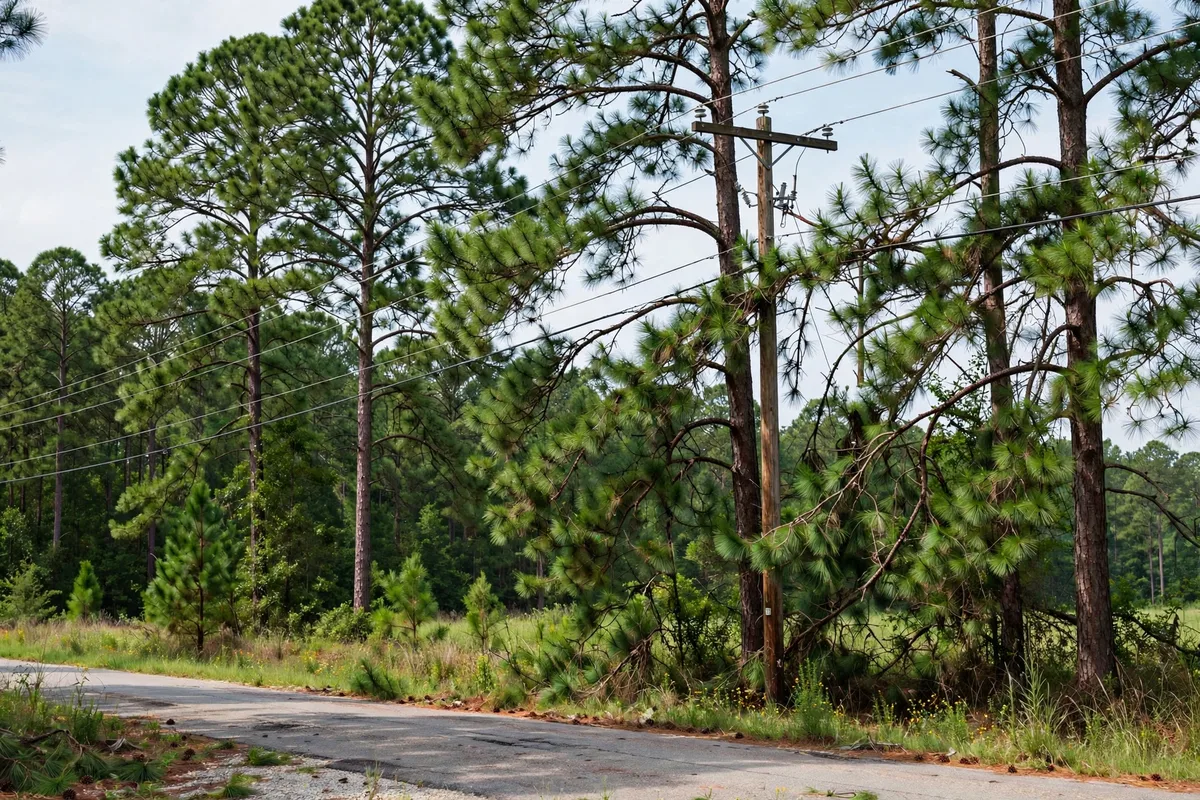
Mississippi homeowners deal with two different kinds of overhead lines, and responsibility splits between them:
Utility power lines (pole to pole): These are the lines running along streets and through easements from pole to pole. The utility that owns them — in most of the Jackson metro, that's Entergy Mississippi — maintains vegetation around these lines as part of its reliability program. If a tree is growing into these lines, that's the utility's job, not yours.
Service drop (pole to your house): The line running from the utility pole to your home's weatherhead is typically the homeowner's responsibility zone. The utility generally won't trim for service drops the way it does for main lines — vegetation threatening your service drop is usually on you to address, by hiring a qualified tree service.
Trees entirely on your property, not touching any lines: Yours, fully. A professional tree trimming company handles these — including preventive pruning that keeps them from ever reaching the lines.
When in doubt about which line is which, call the utility and ask before you call a tree service. Misidentifying the line is how dangerous mistakes happen.
Entergy Mississippi's Vegetation Management Program
Entergy Mississippi — which serves roughly 445,000 customers across 45 Mississippi counties, including the Jackson metro — runs a year-round vegetation management program to keep trees clear of its power lines. A few things Jackson homeowners should know about how it generally works:
- It's cycle-based. Entergy trims along its distribution and transmission lines on planned maintenance cycles, using both ground crews and — notably in Mississippi — helicopter-based aerial saws for hard-to-reach transmission corridors. Your street gets visited on the utility's schedule, not on request (though you can report concerns).
- It's reliability trimming, not landscaping. Utility crews trim to maintain safe clearance and reliable service — often using directional pruning that encourages growth away from lines. The result can look stark. It's not the same as the aesthetic pruning a tree service provides, and it's not meant to be.
- You can report a vegetation concern. Entergy accepts vegetation reports — their published guidance directs customers to call 800-ENTERGY (800-368-3749) to report trees threatening lines, with follow-up inspection. If a tree is actively contacting lines or sparking, treat it as an emergency and call immediately.
- Notification practices exist. For planned cycle trimming, Entergy's published materials describe courtesy notifications (automated calls, door hangers) — though emergency or hazard work may proceed without advance notice.
For the utility's own description of its program, see Entergy's tree trimming and vegetation management page. Utility programs evolve, so check their current page rather than relying on any third-party summary — including this one.
What Homeowners Should NEVER Do
This section isn't hedging — it's the most important part of this article:
Never trim branches within 10 feet of energized power lines yourself. Electricity can arc across gaps — you don't have to touch the line to be electrocuted. Every year, homeowners are killed or seriously injured attempting exactly this.
Never climb a tree that's touching or near power lines. The tree itself can become energized.
Never attempt to pull down a limb that's resting on a line. If it shifts, it can bring the line down with it — or the line can spring back.
After storms: assume every downed line is live. Stay away, keep others away, and call the utility. Only utility crews or their contractors should remove trees or limbs touching power lines — this is stated explicitly in utility storm guidance. If a tree has fallen on lines at your property, call emergency tree service only after the utility has de-energized and cleared the lines; we'll handle the tree once it's safe.
Don't plant the problem in the first place. The cheapest line-clearance strategy is planting the right tree in the right place — small-maturing species under lines, large shade trees well away from them. See our tree planting guide for Mississippi-appropriate species selection.
What a Tree Service Can (and Can't) Do Near Lines
A professional tree service is the right call for everything that ISN'T in the utility's zone:
- Preventive pruning of your trees to maintain clearance from lines before contact happens — the smartest money you can spend
- Trees threatening your service drop (pole-to-house line), which utilities typically don't maintain
- Complete removal of problem trees near lines, coordinated with the utility when de-energizing is needed — we work with utilities on scheduling; we don't work around live lines ourselves
- Storm-damaged trees near lines, once the utility has made the scene safe
- Right tree, right place replanting after a removal near lines
What we can't do: trim within the utility's minimum approach distance of energized conductors. That's line-clearance work requiring specialized training, equipment, and utility coordination. Any tree service that offers to "just trim around the lines real quick" is one to avoid.
Before You Dig or Plant Near Lines: Call Mississippi 811
Planting a replacement tree, installing a fence, or doing any digging near utility easements? Mississippi law requires notification before excavation — call 811 and Mississippi 811 (based in Pearl) notifies member utilities to mark underground lines at no cost to you. Underground electric, gas, and communications lines are just as dangerous as overhead ones when struck. Learn more at the Mississippi 811 website.
Trees and Power Lines: Get the Right Help
If a tree on your property is growing toward lines, don't wait for contact — and don't grab a saw. We'll assess the situation, tell you honestly whether it's a utility matter or a tree-service matter, and handle our part safely.
Call +1 (647) 367-1424 anywhere in the Jackson metro. If it's a utility emergency (sparking, arcing, downed lines), call Entergy Mississippi at 800-368-3749 first, then call us.
Call Now: +1 (647) 367-1424 WhatsApp Request Free Estimate(/contact/)
Sources
- Entergy — Tree trimming and vegetation management (official program page): https://www.entergy.com/tree-trimming
- Mississippi 811 — About Mississippi 811, call-before-you-dig requirements: https://www.ms811.org/about-us/
Frequently Asked Questions
Who do I call if a tree is touching power lines in Jackson, MS?
Call the utility first — for most of the Jackson metro that's Entergy Mississippi at 800-ENTERGY (800-368-3749). If lines are sparking, arcing, or down, treat it as an emergency. Never attempt to move the tree or trim near the lines yourself.
Will Entergy trim the tree in my yard for free?
If the tree threatens Entergy's distribution or transmission lines, their vegetation management program handles it on their maintenance cycle at no charge to you. If the issue is your service drop (pole to house) or a tree not affecting their lines, that's generally the homeowner's responsibility.
How close can I trim to power lines myself?
Don't. Stay at least 10 feet away from overhead lines with yourself, your tools, and your ladder — and remember electricity can arc. Any work within that zone requires qualified line-clearance professionals coordinated with the utility.
Can a tree service remove a tree that's touching power lines?
Only in coordination with the utility. The utility must typically de-energize or clear the lines first; then a tree service can safely perform the removal. Reputable companies will insist on this sequence — be wary of any that don't.
Who cleans up after the utility trims my trees?
Utility trimming debris practices vary — in maintained areas, utilities generally handle or mulch the debris from their maintenance trimming, but practices differ by situation. If you want a thorough cleanup or additional shaping beyond the utility's clearance cut, that's a job for a tree service.
What should I plant under power lines?
Small-maturing species that stay well under the lines at mature height — ornamental trees and large shrubs rather than oaks or pines. Our tree planting guide covers species selection for Mississippi conditions, including planting near utilities.