Last updated: September 21, 2026
The Short Answer: Mississippi Pruning Calendar
| Species | Best months | Key notes |
|---|---|---|
| Live oak / red oak | January–February | Avoid spring pruning (oak wilt risk); dormant season only |
| Southern magnolia | Late winter (Jan–Feb) | Light shaping; heavy cuts heal slowly on magnolias |
| Loblolly / southern pines | Late winter; light pruning anytime | Remove dead limbs any month; avoid heavy summer cuts |
| Crape myrtle | Late winter (Feb–Mar) | Thin and shape — never top ("crape murder") |
| Pecan | Dormant season (Dec–Feb) | Structural pruning while branch structure is visible |
| Bradford pear | Late winter | Structural pruning; consider removal — they split |
| Flowering dogwood | After spring bloom | Blooms on old wood; winter pruning removes flowers |
Dead, broken, or hazardous limbs are the exception to every rule: remove them whenever you see them, whatever the month. Waiting for the "right season" while a dead limb hangs over your driveway is how accidents happen.
If you're unsure what your trees need, our trimming crews assess timing as part of every free estimate — we'll tell you whether the work should happen now or wait for dormancy.
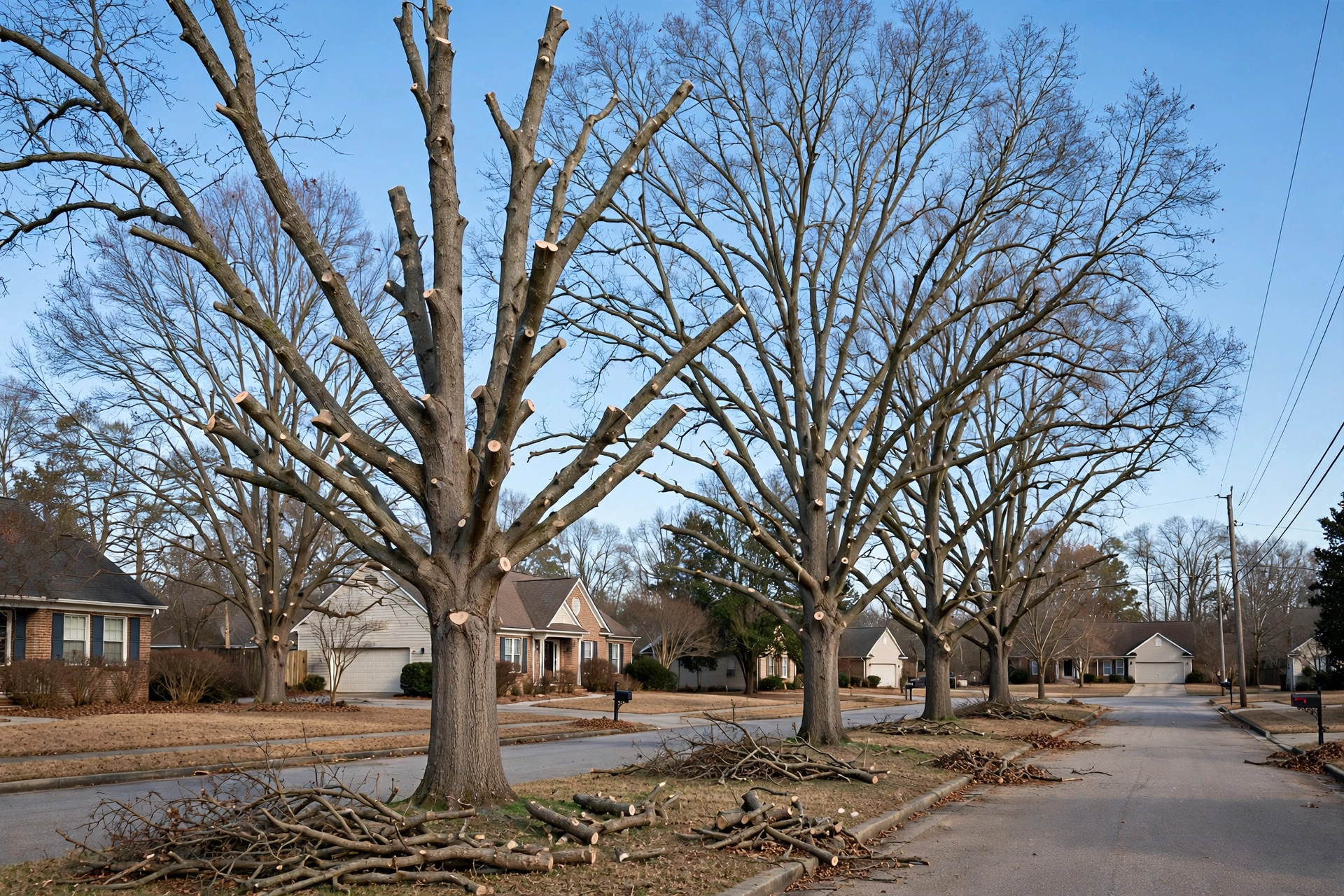
Why Late Winter Wins in Mississippi
Four things make January and February the sweet spot:
Trees are dormant. Without leaves, branch structure is fully visible. A good pruner can see crossing limbs, weak attachments, and deadwood that would be hidden in summer — which means better cuts and less guesswork.
Wounds close faster. Cuts made just before spring growth begins start sealing as soon as the tree leafs out. MSU Extension's pruning guidance notes that most size-control pruning in Mississippi is best done February through April, and warns against stimulating tender new growth before freezes pass (source).
Disease pressure is lowest. Most fungal pathogens and the insects that spread them are inactive in winter. That matters enormously for oaks: fresh spring wounds attract the sap beetles that transmit oak wilt, which is why oak work belongs in the dormant season.
You can see what you're doing. This sounds obvious, but it drives real quality differences. Winter pruning produces cleaner structure because the pruner isn't fighting foliage to evaluate the tree's form.
One caution from MSU Extension's seasonal calendar: don't prune just anything in fall. Pruning stimulates growth, and tender new growth heading into a Mississippi freeze gets damaged — the Extension specifically advises delaying most pruning until February (source).
Species-by-Species Pruning Guide
Live oak and red oaks
Prune in deep dormancy: January through February. Oaks seal wounds well in winter, and — critically — the beetles that spread oak wilt are inactive. Never make major pruning cuts on oaks in spring. Fresh wounds in the warm months attract sap-feeding beetles that can carry the oak wilt fungus from infected trees to your healthy ones. If storm damage forces emergency oak work in spring, wounds should be addressed promptly — this is one of the few situations where prompt wound treatment is warranted.
Southern magnolia
Late winter, light hand. Magnolias don't compartmentalize wounds as aggressively as oaks, so keep cuts minimal and purposeful: remove dead wood, crossing branches, and low limbs for clearance. Never "lion-tail" a magnolia by stripping interior branches — it ruins the tree's natural form and health.
Loblolly and southern pines
Pines are forgiving. The best window is late winter, but light pruning — removing dead lower limbs, clearing roof lines — can happen any time of year. Keep one rule: never remove more than the lower third of a pine's live crown. Over-lifting a pine ruins its wind resistance and starves it.
Crape myrtle
Prune in late winter (February into March in the Jackson area). Thin crowded interior branches, remove suckers from the base, and shape lightly. What you must not do is top them — cutting every branch back to stubs, the practice landscapers call "crape murder." Topping produces weak, whip-like regrowth that's more disease-prone and uglier than the natural form. A properly pruned crape myrtle keeps its graceful branching structure.
Pecan
Dormant season only, December through February. Pecans have naturally strong structure, but young trees benefit enormously from structural pruning: establish a central leader and well-spaced scaffold branches early, and you'll prevent the split crotches that plague mature pecans in storms.
Bradford pear
Late winter for structural pruning — but be honest about the long game. Bradford pears are structurally doomed trees: narrow crotch angles that split under their own weight, usually in the first 15–20 years. Pruning delays the inevitable; removal and replacement with a sturdier species is often the smarter investment.
When NOT to Prune
Spring oak pruning. Covered above, but it bears repeating because it's the costliest timing mistake Mississippi homeowners make. One round of spring pruning cuts on a healthy oak can be an invitation to oak wilt — a disease with no cure once established.
Heavy pruning right before hurricane season. Major canopy reduction in May stresses the tree just as storm season arrives. If you want wind-resistant trees for June through November, do the structural work in winter. Thinning the canopy in dormancy lets wind pass through instead of catching the crown like a sail.
Topping — any species, any season. Topping doesn't control size; it creates decay columns, weak regrowth, and a tree that's more hazardous than before. It's also the fastest way to destroy a crape myrtle's value.
Fall shearing for shape. As MSU Extension warns, fall pruning pushes tender growth that a sudden freeze kills. Save shaping work for late winter.
How Often Do Jackson Trees Need Trimming?
- Young trees (first 5–10 years): structural pruning every 2–3 years. This is the highest-value pruning you'll ever do — small corrections now prevent major failures later.
- Mature shade trees: every 3–5 years for crown cleaning and thinning. Mature live oaks in Madison and Ridgeland on this cycle rarely become emergencies.
- Fast growers (Bradford pear, silver maple, river birch): every 2–3 years, or plan for removal.
- After storms: inspect and prune as needed, regardless of schedule. Ice storms and hurricanes create hangers and splits that don't wait for February.
Trees near roofs, driveways, or power lines should be checked annually even on a relaxed pruning cycle — clearance issues develop faster than most homeowners notice.
Get the Timing Right — Free Assessment
Not sure whether your trees need work now or should wait for winter? That's exactly what our free estimates are for. We'll assess your trees, tell you honestly what can wait, and schedule the work for the right season.
Call +1 (647) 367-1424 — serving Jackson, Brandon, Madison, Ridgeland, Clinton, Pearl, Flowood, Richland, Byram, and Florence.
Call Now: +1 (647) 367-1424 WhatsApp Request Free Estimate
Concerned a tree might be past saving? Read 7 signs your tree needs to be removed before you decide.
Sources
- MSU Extension Service — Pruning Landscape Plants (Publication 3589): http://extension.msstate.edu/publications/pruning-landscape-plants?page=12
- MSU Extension Service — When and How to Prune Landscape Plants: Winter/Early Spring: http://extension.msstate.edu/blog/when-and-how-prune-landscape-plants-winterearly-spring?page=9
Frequently Asked Questions
What is the best month to trim trees in Mississippi?
February is the best all-around month: trees are fully dormant, structure is visible, and cuts begin healing with spring growth. January works equally well for most species. For oaks specifically, stay within the January–February dormant window and avoid any spring pruning due to oak wilt risk.
Can I trim trees in summer in Mississippi?
Light corrective work — removing a broken limb or clearing a branch from your roof — is fine any time. But avoid major pruning in summer: heat stress slows wound closure, and for oaks, summer wounds carry oak wilt risk. Save structural work for late winter when the tree is dormant.
Why can't I prune oak trees in spring?
Fresh pruning wounds in spring attract sap-feeding beetles that transmit oak wilt, a fungal disease that can kill oaks — especially red oaks — within a single season. There is no cure once a tree is infected. Pruning oaks only during dormancy (roughly January–February in central Mississippi) avoids the period when beetles are active.
Should I top my crape myrtle to keep it small?
No. Topping — cutting all branches back to stubs — is called "crape murder" for good reason. It produces weak, fast-growing shoots that are disease-prone and destroy the tree's natural form. Instead, prune in late winter by thinning crowded branches and removing suckers. If the crape myrtle is too big for its spot, it was the wrong variety for that location.
How often should trees be trimmed?
Young trees benefit from structural pruning every 2–3 years; mature shade trees typically need professional attention every 3–5 years. Fast-growing species like Bradford pears need more frequent work. Trees near structures or power lines should be inspected annually regardless of the pruning cycle.