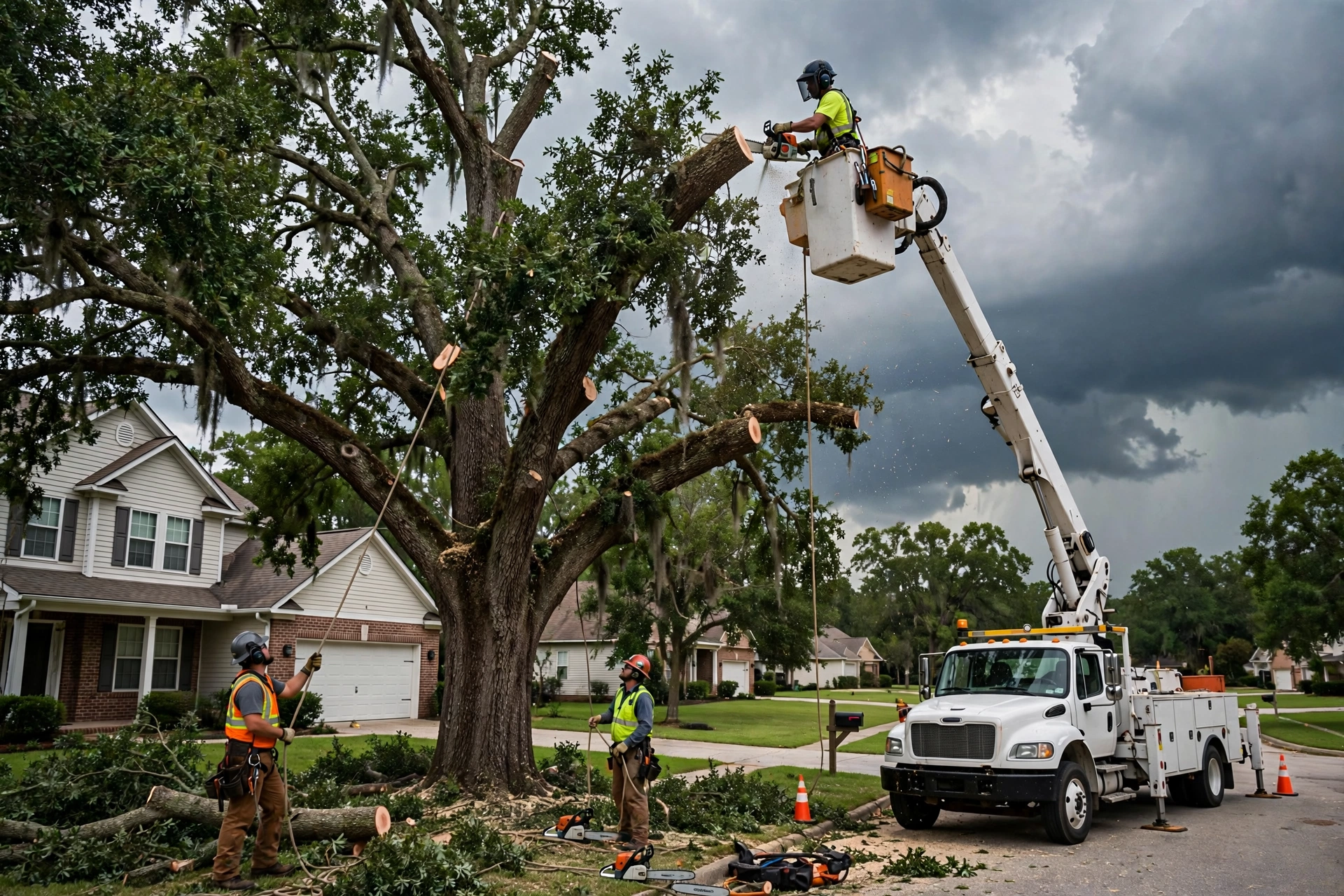
Mississippi's Storm Threats, by Season
Hurricanes get the headlines, but Jackson-area trees face year-round threats. Knowing what's coming — and when — is the first step in protecting your property:
| Threat | Peak season | What it does to trees |
|---|---|---|
| Hurricanes & tropical storms | June 1–November 30 | Sustained high winds snap limbs, uproot shallow-rooted trees, and turn dead branches into projectiles |
| Tornadoes | March–May (spring) | Violent, localized winds that can level entire stands regardless of tree health |
| Ice storms | December–February | Ice loading snaps limbs — especially on Bradford pears and weak-wooded species |
| Straight-line winds & severe thunderstorms | Year-round | Sudden gusts exploit existing weaknesses: deadwood, cracks, and poor structure |
The takeaway: if you only think about your trees when a hurricane is in the forecast, you're already late. The work that saves homes happens in spring — April and May are the ideal window for pre-season pruning in the Jackson metro.
The Pre-Season Tree Inspection Checklist
Walk your property every spring with this 8-point checklist. What you find now determines what survives the next storm:
- Remove deadwood. Dead branches are the first things to break in high wind — and they become projectiles. If a limb has no leaves in growing season, brittle bark, or fungal growth, it needs to come down. This is the single highest-value storm-prep task.
- Thin dense canopies. A thick, sail-like canopy catches wind; a thinned canopy lets it pass through. Professional crown thinning reduces wind resistance dramatically — this is the core of hurricane-season pruning.
- Cut the hangers. Broken limbs caught in the canopy ("widow-makers") will fall in the next big wind event. They are unpredictable and dangerous — have them removed professionally, not with a ladder and a handsaw.
- Check for new lean. Walk around each large tree and sight up the trunk. Any lean that wasn't there last year is a red flag — especially after extended rain on Yazoo clay, which loosens root systems as it swells and shrinks.
- Clear limbs from your roof. Limbs should clear the roofline by at least 6–10 feet. In a storm, a limb doesn't need to break your roof to damage it — repeated whipping in high wind strips shingles and gutters.
- Assess tall pines near the house. Loblolly pines are tall, fast-growing, and brittle in storms. A pine within striking distance of your home deserves a professional structural assessment every couple of years.
- Stake young trees — correctly. Newly planted trees need staking for their first year or two, but stakes left on too long weaken the trunk. Check that ties are loose and stakes come out on schedule.
- Inspect the root zone. Look for soil heaving around the root flare, exposed roots, or cracks in the soil on one side of the trunk. These are signs the root system is compromised — the tree may look fine above ground while failing below it.
Found two or more red flags? Don't wait for the forecast. Call +1 (647) 367-1424 for a free pre-season assessment — April and May slots fill fast.
Which Trees Fail First in Mississippi Storms
Not all trees are equal in high wind. In the Jackson metro, these are the usual suspects when storms roll through:
- Bradford pear — the undisputed champion of storm failure. Weak branch unions mean mature Bradford pears split apart in moderate wind. If you have one near your house or driveway, seriously consider removal before it removes part of your roof.
- Water oak — fast-growing, weak-wooded, and short-lived. Sheds massive limbs in storms and rots from the inside, so it can look healthy while structurally compromised.
- Tall loblolly pines near structures — height plus brittleness plus shallow storm vulnerability. Fine in a stand of pines; a liability six feet from your bedroom.
- Previously damaged trees — a tree that lost a major limb in a past storm, or was "topped" years ago, has weak regrowth and internal decay. Old damage is a predictor of future failure.
- Trees with root damage — construction-damaged roots, compacted soil, or Yazoo clay movement. The canopy looks normal; the anchoring is gone.
The pattern: weak wood + poor structure + compromised roots = storm casualty. A professional assessment identifies all three before the wind does.
Don't Forget Tornado Season
Here's what out-of-state storm guides get wrong about Mississippi: hurricanes aren't our most frequent tree-killer — tornadoes are. Central Mississippi sits in Dixie Alley, the Southeast's tornado corridor, where spring storms (March through May) spin up fast-moving twisters, often at night and often rain-wrapped. A tornado doesn't care how healthy your tree is; EF2+ winds level entire stands.
The good news: tornado prep and hurricane prep are the same work. Deadwood removal, crown thinning, hanger removal, and structural assessments protect against both — the pruning you do in April and May covers you for spring tornadoes and the June–November hurricane season in one pass. That's why we push the spring assessment window so hard: one round of professional tree work buys you two seasons of protection.
After any tornado or severe thunderstorm — even if your trees "look fine" — get a post-storm inspection. Twisted trunks, cracked root plates, and partially torn limbs fail weeks later in ordinary wind. If your yard is a mess of downed limbs and debris, our storm damage cleanup crews handle the full restoration, not just the hazardous removals.
Ice Storms Damage Mississippi Trees Too
Winter is the forgotten storm season. When freezing rain coats branches in ice, the added weight snaps limbs — especially on weak-wooded species like Bradford pear, silver maple, and water oak — and can split entire crowns off mature trees. A half-inch of ice adds roughly 500 pounds of load to a medium tree.
What to check after an ice event: bent or cracked limbs that didn't fully break (they'll fail in the next wind), bark stripped where limbs tore, and evergreens splayed outward under the load. Don't try to shake or beat ice off branches — you'll break more than the ice would. Let it melt, then have damaged limbs properly pruned back to healthy wood. And if ice brought down a large limb onto your roof or driveway, that's what our emergency tree service is for.
What NOT to Do Before Storm Season
Good intentions cause bad outcomes when the advice is wrong. Avoid these common mistakes:
- Don't top your trees. Topping — cutting the crown back to stubs — is sometimes sold as "storm-proofing." It does the opposite: it triggers weak, fast-growing shoots that break easily, opens massive wounds to decay, and can kill the tree. Topped trees are more dangerous in storms, not less.
- Don't do heavy pruning right before a storm. Major pruning stresses trees. The sweet spot is spring — April through May — which gives wounds time to begin sealing before hurricane season peaks in August and September.
- Don't DIY dangerous removals. A leaning tree, a tensioned limb, or anything near power lines is professional-only work. Storm-season ER visits spike from exactly this kind of DIY work.
- Don't ignore the small stuff. That dead limb you've been meaning to deal with for two years? In 70-mph wind, it's a missile aimed at your roof.
After the Storm: Assessment Steps
The storm passed. Now work through this sequence — in order:
- Stay clear of downed lines. Assume every downed power line is live. Do not touch trees entangled with lines — call your utility company first, then call us for everything beyond their clearance zone.
- Photograph everything. Document all tree damage before any cleanup begins — wide shots and close-ups. Your insurance adjuster will want these, and our emergency crews document damage professionally as part of every storm response.
- Check for new lean and hangers. Walk the property once it's safe. Any tree leaning in a new direction, or with broken limbs caught in the canopy, needs professional assessment before the next wind event.
- Don't cut tensioned limbs yourself. A limb bent under load stores enormous energy — when cut, it can snap back violently. This is the single most dangerous DIY tree task there is.
- Call for a professional assessment. Even trees that "look fine" can have cracked root plates or split trunks that fail weeks later. A post-storm inspection catches what you can't see from the ground.
Tree on your house or blocking your driveway right now? Our emergency tree service covers Hinds, Rankin, and Madison counties. Call +1 (647) 367-1424.
Your Year-Round Prevention Plan
Storm prep isn't a once-a-year scramble — it's a maintenance rhythm:
- Every spring: walk the 8-point inspection checklist above; schedule pre-season pruning in April–May.
- Every 3–5 years: professional pruning cycle for mature trees (crown cleaning and thinning).
- After every major storm: post-storm assessment, even if nothing looks wrong.
- When planting: choose storm-resistant species for Mississippi — live oak, bald cypress, and southern magnolia handle wind far better than Bradford pear or water oak. (See our tree planting guide for species selection.)
Consistent, boring maintenance beats heroic emergency response every time — and it costs a fraction of what storm damage does.
Get Your Pre-Season Assessment — Before the Forecast
April and May are the window. Once hurricane season is underway, every tree company in the metro is booked solid with emergency work — and pre-season rates beat emergency rates every time.
Call +1 (647) 367-1424 for a free storm-prep assessment. We'll walk your property, flag the risks, and give you a written quote with no obligation — across Jackson, Brandon, Madison, Ridgeland, Clinton, and the full metro.
Call Now: +1 (647) 367-1424 WhatsApp Request Free Estimate
Jackson Tree Pros — Professional tree care for the Greater Jackson, Mississippi area. Hurricane season dates per the National Hurricane Center (nhc.noaa.gov).
Frequently Asked Questions
When should I start preparing my trees for hurricane season?
Spring — ideally April and May. That gives pruning wounds time to begin sealing before the season peaks in August and September, and it gets the work done before summer storm activity ramps up. Booking early also beats the pre-season rush.
Does thinning a tree's canopy really help it survive hurricanes?
Yes. A dense canopy acts like a sail, catching wind and multiplying the force on the trunk and roots. Professional crown thinning opens the canopy so wind passes through, significantly reducing the load on the tree's structure. It's the single most effective storm-prep pruning technique.
My tree started leaning after the storm. Is it dangerous?
Treat any new lean as urgent until a professional says otherwise — especially in Jackson's Yazoo clay soil, where saturated ground lets root systems shift. A leaning tree can fail in the next wind event, not just the one that caused the lean. Call for an assessment promptly.
Will my homeowner's insurance pay for preventative tree removal?
Generally, no — insurers typically don't cover removing a healthy-but-risky tree before anything happens. But if a tree falls on your home, vehicle, or other structure, removal and repairs are often covered. Document pre-existing conditions with photos, and confirm the details with your insurance agent.
Should I top my trees to make them storm-safe?
No — topping makes trees more dangerous in storms, not less. It produces weak, fast-growing shoots attached to decaying stubs, which break easily in wind. Proper crown thinning and reduction by a professional crew is the correct way to reduce storm risk.
Are tornadoes or hurricanes worse for Jackson-area trees?
For sheer frequency of tree damage, tornadoes and severe spring thunderstorms hit the Jackson metro harder than hurricanes in most years — we're in Dixie Alley, after all. The reassuring part is that the same spring tree work (deadwood removal, thinning, structural assessment) protects against both tornado season and hurricane season.
What should I do about ice-damaged limbs?
Let the ice melt on its own — never beat or shake ice off branches. Once it's melted, have cracked or partially torn limbs professionally pruned back to sound wood; damaged limbs left hanging will fail in the next wind event. Large limbs on structures need prompt professional removal.